

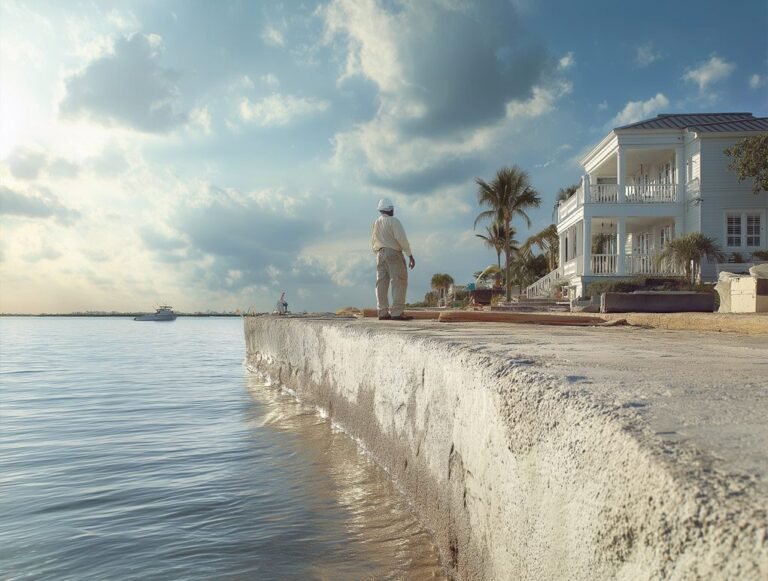
Owning waterfront property in the Florida Keys comes with a distinct set of responsibilities. Seawalls are not decorative shoreline features; they are load-bearing structures that protect land, foundations, and utilities from constant hydraulic pressure. In places like Islamorada, seawalls operate under daily stress from tides, saltwater exposure, shifting soils, and seasonal storm activity.
Seawall damage rarely presents itself as an emergency at first. Small cracks, surface spalling, or minor leaning are easy to dismiss, especially when the structure still appears functional. The problem is that seawalls fail progressively. When early warning signs are ignored, the resulting damage is often far more extensive and costly than homeowners expect.
The following seven mistakes are among the most common—and expensive—errors Florida Keys homeowners make when seawall deterioration is treated as a low-priority issue rather than a structural risk.
Table of Contents
Seawall neglect as a compounding structural problem
A seawall’s purpose is to resist lateral pressure from retained soil and water. When that resistance weakens, the surrounding environment begins to change. Water moves where it should not, soils shift, and structural loads redistribute in ways the property was never designed to accommodate.
For homeowners considering seawall repair islamorada, the critical realization is that delay allows multiple forms of damage to develop simultaneously. What starts as a repairable wall issue often expands into broader shoreline, foundation, and environmental problems that require far more invasive intervention.
Why early damage is easy to underestimate
Seawall deterioration is deceptive.
- Structural weakening occurs below the waterline
- Soil loss happens behind the wall, out of sight
- Drainage failures progress internally
By the time surface damage becomes obvious, the underlying structure has often been compromised for years.
1. Treating visible cracks as cosmetic rather than structural
One of the most common mistakes is assuming that surface cracks are purely cosmetic. In seawalls, cracks often indicate deeper issues such as reinforcing corrosion, concrete fatigue, or differential movement.
Cracks allow water to penetrate the wall, accelerating internal deterioration and increasing hydrostatic pressure behind the structure.
Why this mistake escalates cost
Ignoring cracks increases repair scope.
- Water intrusion accelerates internal damage
- Reinforcement corrosion expands and weakens concrete
- Repairs shift from localized sealing to structural stabilization
What could have been addressed early often becomes a full rehabilitation project.
2. Ignoring soil washout behind the seawall
Soil erosion behind a seawall is one of the most damaging and least visible consequences of wall failure. As water passes through cracks or failed joints, it carries fine soil particles away from behind the wall, creating voids.
These voids undermine patios, walkways, pools, and even building foundations.
How washout creates cascading damage
Soil loss rarely remains contained.
- Surface settlement spreads inland
- Drainage patterns change unpredictably
- Load-bearing capacity decreases
Repairing the seawall alone may not restore stability once significant washout has occurred.
3. Delaying action until flooding becomes frequent
Many homeowners wait to address seawall damage until flooding becomes noticeable during high tides or storms. By this stage, the wall has already lost much of its effectiveness as a barrier.
In the Florida Keys, where tidal ranges and storm surge are routine considerations, this delay significantly increases exposure.
Why flooding is a late-stage indicator
Flooding reflects advanced failure.
- Wall height or integrity has already diminished
- Pressure relief systems are compromised
- Surrounding soils are saturated and unstable
At this point, repairs are more disruptive and expensive.
4. Assuming temporary patches will halt deterioration
Surface patching, crack filling, or coating application can make a seawall look improved in the short term. However, these measures rarely address the underlying structural issues causing the damage.
Temporary fixes often create a false sense of security that delays proper assessment.
The hidden cost of short-term fixes
Temporary measures increase long-term expense.
- Structural damage continues behind repairs
- Monitoring becomes less reliable
- Emergency failure risk remains unchanged
Ultimately, homeowners pay for both the temporary fix and the eventual full repair.
5. Overlooking foundation and utility impacts
Seawall failure affects more than the shoreline edge. As soils shift and settle, underground utilities, slab edges, and foundation systems experience stress.
Cracks or movement in structures farther from the water are often misattributed to age or normal settlement.
Why these impacts are misdiagnosed
The connection is not always obvious.
- Damage appears away from the shoreline
- Progression is slow and irregular
- Symptoms resemble unrelated structural issues
Without addressing the seawall, repairs elsewhere may fail repeatedly.
6. Waiting until permitting and compliance become urgent
Environmental regulations in the Florida Keys are strict, particularly where shoreline work may affect marine habitats. When seawall damage is addressed early, permitting is often simpler and more flexible.
As damage worsens, regulatory scrutiny increases.
How delay complicates compliance
Advanced deterioration triggers additional oversight.
- Expanded environmental assessments
- Restricted construction windows
- Increased documentation and review
These requirements extend timelines and raise costs significantly.
7. Underestimating the impact on property value and insurability
Seawalls are a major factor in the valuation of waterfront property. Visible damage signals deferred maintenance and potential hidden costs to buyers, insurers, and lenders.
Even if a sale is not imminent, ignoring seawall damage reduces financial flexibility.
Market consequences of neglected seawalls
Seawall condition influences key decisions.
- Buyers demand price reductions or repairs
- Insurers reassess risk exposure
- Financing terms become more restrictive
Value erosion often begins long before structural failure occurs.
Why seawall damage rarely stays isolated
Seawalls function as part of a broader coastal protection system that includes retained soils, drainage paths, adjacent structures, and marine conditions. Coastal engineering emphasizes system behavior rather than isolated components. A general explanation of seawall function within coastal protection systems is outlined in Wikipedia’s overview of seawalls, which describes how these structures interact with wave energy, erosion, and shoreline stability.
From this system perspective, seawall damage affects everything connected to the shoreline, not just the wall itself.
The cost difference between early repair and late intervention
One of the most misunderstood aspects of seawall maintenance is cost trajectory. Early-stage repairs are typically targeted and localized. Late-stage interventions often involve excavation, soil stabilization, structural reinforcement, and extended permitting.
The difference is not incremental; it is exponential.
How costs escalate over time
- Repair scope expands beyond the wall
- Access becomes more difficult
- Temporary stabilization is required during work
Delaying action shifts projects from maintenance to reconstruction.
Why Florida Keys conditions accelerate deterioration
Islamorada and the surrounding Keys expose seawalls to particularly aggressive conditions.
- Constant saltwater exposure accelerates corrosion
- Tidal cycling increases fatigue
- Storm events impose short-term extreme loads
Structures designed decades ago may already be operating near their design limits.
When homeowners should reassess seawall condition
Certain indicators suggest that ignoring seawall damage is no longer a safe option.
- Recurrent pooling or flooding near the wall
- Visible cracking, leaning, or separation
- Soft or settling soil behind the structure
- Difficulty maintaining docks or adjacent features
These signs warrant professional evaluation rather than continued observation.
Reframing seawall maintenance as risk control
Seawall repair is often viewed as discretionary maintenance. In reality, it is risk management. Addressing damage early protects land stability, structural integrity, environmental compliance, and property value simultaneously.
Waiting rarely preserves optionality; it narrows it.
Benefits of timely intervention
- Lower total repair impact
- Reduced regulatory complexity
- Improved long-term shoreline stability
Early action preserves both physical and financial resilience.
Closing perspective: the real cost of inaction
Ignoring seawall damage is rarely a neutral decision. It allows multiple forms of risk to develop quietly, each compounding the next. For Florida Keys homeowners, the cost of inaction often exceeds the cost of repair—not just financially, but in lost time, increased disruption, and reduced control over outcomes.
Seawalls are foundational infrastructure for coastal properties. Treating early damage seriously is not an overreaction; it is a practical response to how these structures behave over time. When homeowners address seawall issues before failure accelerates, they protect not only the shoreline, but the long-term stability and value of their property.


