

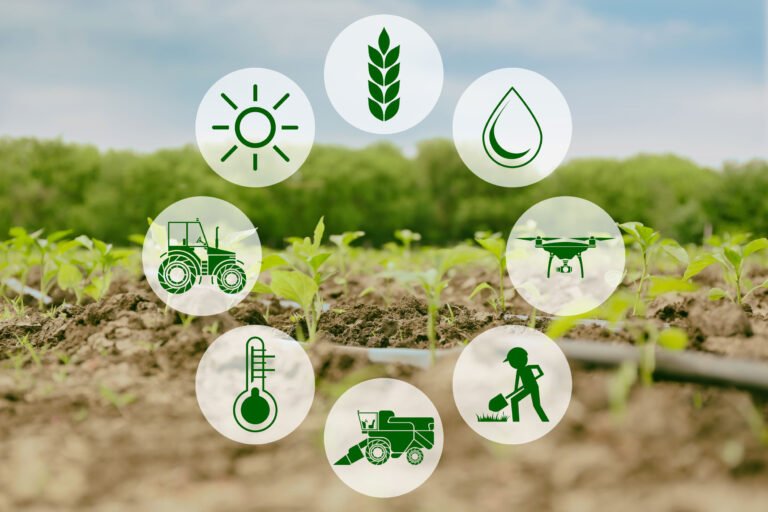
Indian farming is moving through a major shift driven by rising costs, labour shortages, and climate uncertainty. Farmers now need practical methods that save effort while protecting crop quality.
The smart agriculture market in India is expected to reach US$ 357.9 million by 2033, with a 17.3 percent compound annual growth rate between 2026 and 2033. These figures show that smart farming is becoming more than a trend.
For small and marginal farmers, smart farming offers control and clarity. It helps you manage crops better without relying on heavy machinery or complex systems. This blog explains how smart farming works, why it matters, and what it means for your farm.
Table of Contents
What is Smart Farming? Understanding the Concept
Smart farming focuses on using technology to improve everyday farm decisions. It relies on timely information rather than guesswork.
You use data, tools, and services to apply the right input at the right time. This approach helps you reduce waste and improve results.
Traditional Farming vs Smart Farming
| Aspect | Traditional Farming | Smart Farming |
| Decision making | Based on experience | Based on data and insights |
| Input application | Uniform and manual | Targeted and precise |
| Labour requirement | High | Lower |
| Monitoring | Visual inspection | Digital and aerial support |
| Cost control | Limited | Improved through precision |
Core Objectives of Smart Farming
- Improve crop productivity through better timing
- Reduce input wastage and unnecessary costs
- Lower physical effort and health risks
- Support sustainable farming practices
- Help farmers make informed decisions
Why Smart Farming is Gaining Momentum in India
Several structural and economic factors are accelerating adoption across regions. These drivers are closely linked to everyday farming realities.
Rising Food Demand
India’s growing population continues to increase food demand. Farmers are expected to produce more using limited land resources. Smart farming supports better output without expanding cultivated areas.
Labour Availability Challenges
Seasonal labour shortages affect spraying, monitoring, and harvesting activities. Wage costs are also increasing across many regions. Technology helps you manage operations with fewer workers.
Climate Variability
Unpredictable rainfall and temperature shifts create production risks. Traditional methods often respond too late to stress conditions. Smart tools help detect issues earlier and respond faster.
Key Technologies Driving Smart Farming in India
Smart farming combines multiple technologies that work together at different crop stages. Each tool supports efficiency, accuracy, and better decision-making. These technologies are designed to fit Indian field conditions and resource limitations:
Drones for Precision Agriculture
Drones support spraying, monitoring, and mapping tasks across different crops. You can cover fields faster while maintaining consistent application quality. This improves timing and reduces manual dependence.
- Uniform crop spraying
- Early crop stress detection
- Field mapping
Soil and Crop Sensors
Sensors measure moisture, temperature, and nutrient levels directly from the field. This real-time data helps you plan inputs more accurately. Decisions become need-based rather than assumption-driven.
- Avoid over-irrigation
- Timely nutrient application
- Improved crop health
Mobile-Based Farm Management Tools
Mobile applications support daily farm planning and record keeping. These tools simplify management tasks and reduce paperwork. Many platforms are designed for easy use on basic smartphones.
- Task reminders
- Expense tracking
- Advisory alerts
Satellite and Remote Sensing Support
Satellite images provide a wider view of crop conditions across larger areas. These insights help identify uneven growth or stress patterns early. Planning becomes more proactive and organised.
- Monitoring large fields
- Identifying problem zones
- Planning corrective actions
Basic Automation Tools
Automation supports repetitive tasks such as spraying and irrigation. These tools reduce the need for continuous manual involvement. Operations become more consistent and less physically demanding.
- Consistent task execution
- Time savings
- Reduced physical strain
How Smart Farming is Changing Day-to-Day Farm Operations
Technology is influencing how routine tasks are planned and executed. The changes are visible across crop cycles.
Precision Input Application
Smart systems support targeted input use across different field zones. Fertilisers and pesticides are applied only where required. This reduces waste and improves crop response during key growth stages.
Improved Crop Monitoring
Aerial and sensor-based monitoring offers better visibility across the entire field. Stress areas are identified early and more accurately. You can respond before damage spreads widely or becomes costly.
Time and Labour Management
Automation reduces time spent on repetitive and labour-intensive tasks. Field operations are completed faster with fewer workers. This supports better scheduling and reduces pressure during peak seasons.
Benefits of Smart Farming for Small and Marginal Farmers
Smart farming offers clear advantages for small landholders. These benefits directly affect productivity and income.
- Cost Control: Reduced input waste helps lower overall cultivation expenses over multiple seasons, improving affordability without increasing workload or dependency on additional resources.
- Improved Safety: Reduced direct exposure to pesticides and fertilisers lowers long-term health risks, especially during frequent spraying activities across different crop cycles.
- Better Yield Consistency: Balanced crop growth across fields reduces uneven yields, helping you achieve more predictable output and minimise losses caused by over- or under-treatment.
- Labour Efficiency: Technology reduces reliance on large labour teams, allowing timely operations even during peak seasons when workers are scarce or costly.
- Informed Decision-Making: Data-backed insights replace guesswork during critical crop stages, helping you respond faster to stress, nutrient needs, or pest activity.
Challenges Slowing Smart Farming Adoption
Despite the benefits, some challenges slow adoption. Addressing these issues is important for wider acceptance.
- Awareness Gaps: Many farmers remain unfamiliar with available technologies and their practical benefits.
- Infrastructure Constraint:s Power supply and network connectivity vary across rural regions.
- Affordability Concern:s Technology is often perceived as expensive without understanding service-based access.
- Skill and Training Need:s More training and demonstrations are required for confident usage.
The Role of AgriTech Companies and Service Models
AgriTech companies play a central role in smart farming growth. Many focus on service-based access rather than product sales.
These companies provide tools, training, and local support. Service models help farmers use technology without an ownership burden.
Key contributions
- Affordable access through services
- Local operator networks
- Training and awareness programmes
- Technical and operational support
The Future of Smart Farming in India
Smart farming is expected to grow steadily across crops and regions. Technology will become more accessible and simpler to use.
Future trends may include:
- Greater use of predictive tools
- Expansion of shared service models
- Stronger focus on climate-resilient practices
These changes will further integrate technology into everyday farming.
Conclusion
Smart farming is reshaping Indian agriculture by improving how everyday decisions are made. It replaces guesswork with timely insights and practical tools.
For small and marginal farmers, smart farming reduces effort while improving control over crops and costs. These benefits support long-term farm sustainability.
As technology becomes more accessible, smart farming will move from early adoption to regular practice. With the right support, you can adopt these methods confidently and effectively.


