

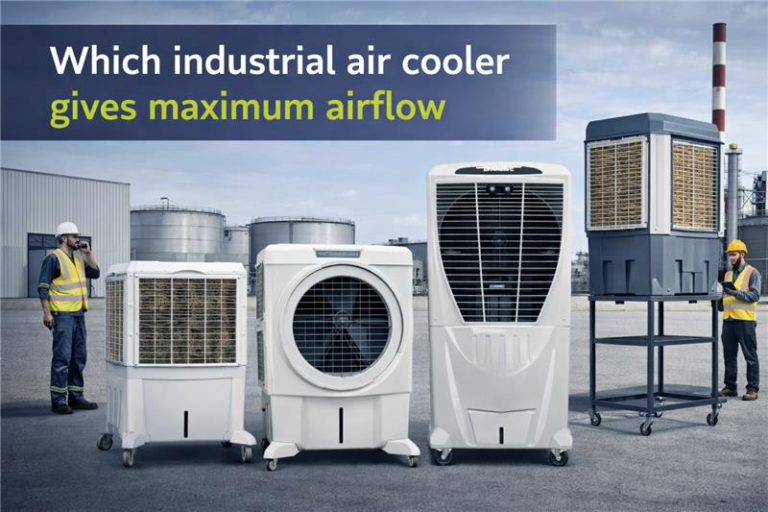
Just think for a second, you are strolling into a busy production floor on a hot summer morning.
The first thing that you observe is not the noise but the heat that comes out of the room. In such spaces, airflow becomes a crucial factor.
The best industrial air cooler, like the Symphony Movicool L 125, is developed specifically for this reason. It pushes a wide stream of air across wide areas rather than cooling only at close proximity.
Maximum airflow is not about a dramatic turn when it is near the outlet. It is about how consistently air travels through the entire working zone.
Choosing the right cooling setup for a large industrial space requires a different mindset. Bigger rooms behave differently from homes or small offices.
Air must move farther, circulate evenly, and remain steady during long operating hours. That is where understanding airflow becomes essential.
Table of Contents
Define maximum airflow in short words.
Certain buyers think airflow means how strong the air feels while standing next to the unit. That impressing can be misnorming. True airflow performance is measured by how effectively air moves across a distance and fills the usable space.
In large environments, good airflow should:
- Reach workstations that sit far from the cooler
- Maintain uniform circulation instead of forming hot pockets
- Continue performing even after hours of continuous use
In case cooling feels uneven, airflow is usually the missing point.
How important is air delivery?
Air delivery indicates the amount of air the cooler can shift within a specific time duration. When it comes to higher delivery values, it is generally translated into stronger circulation, particularly in larger rooms.
- Does air throw really matter?
Air throw determines how far the air can travel. Without sufficient throw, even a powerful unit may struggle to cool distant areas.
- Does tank capacity affect airflow?
Tank size mainly affects operating duration. A larger tank supports longer running cycles without frequent refills. In the meantime, it does not directly expand airflow, but contributes to stable cooling for a long period.
Is it possible for a commercial air cooler to manage industrial spaces?
A commercial air cooler performs optimally when it is used for moderately large spaces like showrooms or retail floors. While industrial environments demand stronger airflow and durability.
Commercial units fit when:
- The space is large, but heat generation is limited
- Continuous heavy-duty operation is not required
- Airflow distances are moderate
For factories or warehouses, industrial models usually perform better.
What should you consider for an air cooler for factory use?
Factories introduce unique challenges. Machinery, dense layouts, and heat sources influence airflow behavior.
Key priorities include:
- Strong air throw along production lines
- Reliable motors suited for extended running
- Sturdy construction for demanding conditions
- Accessible maintenance points for dusty settings
An air cooler for factory setups should emphasize endurance as much as performance.
What works best for an air cooler for warehouse environments?
Warehouses are normally wide and open. Cooling such areas depends heavily on broad air movement instead of concentrated airflow.
Important considerations:
- Wide air spread to reduce temperature variations
- Stable delivery capable of covering long aisles
- Consistent circulation during long work shifts
An air cooler for warehouse applications benefits from thoughtful positioning that encourages natural air paths.
Is an air cooler for a workshop different?
Workshops often combine compact layouts with frequent movement and mechanical activity.
Effective workshop cooling requires:
- Adjustable airflow direction
- Controlled delivery that avoids excessive turbulence
- Durable bodies resistant to minor impacts
An air cooler for workshop areas should offer flexibility without sacrificing strength.
How does placement affect airflow efficiency?
Even the most capable cooler can underperform when positioned poorly. Airflow depends as much on location as equipment design.
Useful placement practices:
- Keep the outlet path unobstructed
- Align airflow with open sections of the space
- Avoid directing air immediately into walls or barriers
- Encourage cross ventilation whenever possible
Correct placement often improves perceived cooling without changing the unit itself.
How many coolers are ideal for very large spaces?
Relying on a single oversized unit may not always deliver balanced airflow. Multiple coolers arranged strategically can improve distribution.
Advantages of distributed setups:
- Better coverage across wide areas
- Reduced likelihood of stagnant zones
- More uniform temperature experience
Large spaces respond well to layered airflow strategies.
How should you interpret the industrial air cooler price?
Price comparisons should extend beyond initial cost. Industrial cooling decisions involve long-term considerations.
When evaluating the industrial air cooler price, reflect on:
- Coverage capability relative to room size
- Power usage patterns
- Maintenance accessibility
- Durability expectations
- Operating efficiency over time
Lower upfront cost does not always mean lower total expense.
Which industrial air cooler should Indian buyers focus on?
Within the industrial air cooler India market, selection should revolve around airflow dynamics and reliability rather than cosmetic features.
Practical evaluation points:
- Air delivery suited to room volume
- Throw adequate for spatial depth
- Construction quality for heavy use
- Ease of servicing
Cooling effectiveness begins with airflow compatibility.
Which industrial air cooler gives maximum airflow?
There is no universal answer because airflow needs vary across locations. Maximum performance comes from matching cooler capabilities with spatial realities.
Instead of chasing a single “best” label, assess:
- Room dimensions and layout patterns
- Heat concentration zones
- Ventilation conditions
- Daily operating duration
A heavy duty air cooler that aligns with these factors will naturally deliver stronger results.
What defines the best industrial air cooling choice?
The best industrial air cooling selection depends on the application context rather than absolute size or power.
Strong candidates typically offer:
- Balanced air throw and spread
- Reliable motors for prolonged operation
- Durable body materials
- Straightforward maintenance design
This is where real-world suitability becomes crucial instead of over-the-top specifications.
Conclusion
Airflow is the backbone of effective cooling in large environments. A thoroughly selected industrial air cooler transforms not merely temperature, but productivity and comfort.
When the entire concentration is on throw distance, placement logic, long-term operating efficiency, and airflow delivery, decision-makers have the ability to curate spaces that are noticeable in a workable condition even during demanding conditions.
Maximum airflow is never a coincidence. It is the result of selecting equipment that genuinely fits the space it is meant to serve.


