

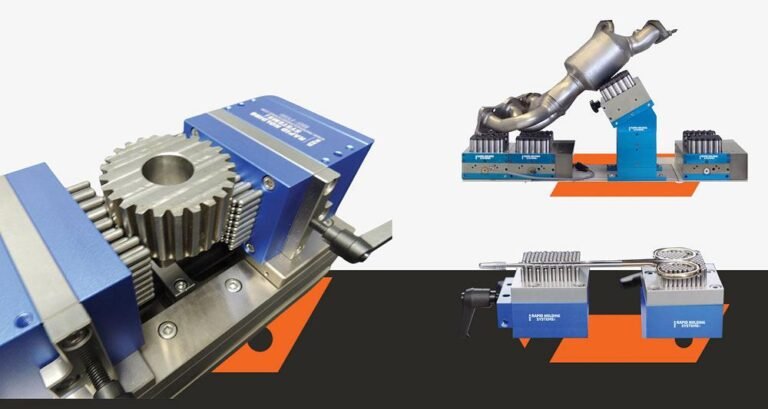
Industrial automation is not only around speed anymore. Today it is all about precision, affordability and the ability to work through complex tasks without breaking flow. One thing that has silently become integral to this evolution is gripping and clamping systems.
Robots work fast, calculate rationally and labor with no sleep. Yet even the most sophisticated automated setup can flounder without the proper gripping and clamping solutions. It may be selecting sensitive parts, lifting heavy metal sheets or swapping between different product variants, the quality of grip frequently equates to the quality of output.
That is why, when it comes to next generation industrial automation, the focus is on smarter and more adaptable gripping and clamping technologies. Here, we will take a closer look at how these setups are changing, the function of contemporary grippers and why they’re driving the future of manufacturing.
Why Gripping, Clamping and Holding Are the Future of Manufacturing
Clamping and gripping were basically mechanical, static as well as application specific in conventional production. One range, one stratagem, one procedure. That approach doesn’t work anymore.
Modern factories deal with:
● High-mix, low-volume production
● Frequent changeovers
● Delicate components alongside heavy parts
● Collaborative robots working near humans
● Tighter quality and safety standards
In this environment, gripping and clamping solutions must be flexible, reliable, and fast. A poor grip can slow down cycles, damage parts, or even halt production entirely. That’s why advanced gripping is no longer an accessory, it’s a core automation requirement.
Table of Contents
The Rise of Intelligent Grippers in Automation
Grippers today are far more than simple open-and-close tools. They are engineered systems designed to adapt to changing tasks while maintaining consistency.
A modern gripper for robotic arm applications must:
● Adjust grip force dynamically
● Handle different shapes and materials
● Minimise surface damage
● Integrate with sensors and control systems
● Operate reliably at high speeds
This shift has led to the development of multiple advanced gripper technologies, each solving a specific automation challenge. Many of these grippers are designed to handle precision components produced by plastic injection molding companies in florida, where tight tolerances and consistent part quality are essential for automated handling.
Universal Robot Grippers: Flexibility at the Core
One of the biggest shifts in automation is the growing demand for flexibility. This is where the universal robot gripper comes into play.
Unlike task-specific grippers, universal grippers are designed to handle a wide variety of parts without frequent tool changes. They are especially valuable in environments where product designs change often or batch sizes are small.
Key benefits include:
● Reduced downtime during changeovers
● Lower tooling costs
● Faster commissioning of new product lines
● Simplified programming
While a universal robot gripper may not always outperform specialised grippers in extreme conditions, its versatility makes it a strong choice for flexible automation setups, labs, and smart factories.
Pneumatic Grippers: Reliable and Industry-Tested
Despite all the new technologies entering the market, pneumatic grippers continue to hold a strong position in industrial automation.
Their popularity comes from simplicity and reliability. Powered by compressed air, pneumatic grippers are easy to control, cost-effective, and capable of delivering consistent gripping force across millions of cycles.
Why industries still rely on pneumatic grippers:
● Proven technology with predictable behaviour
● High gripping force relative to size
● Easy integration with existing pneumatic systems
● Low maintenance requirements
In assembly lines, packaging units, and automotive plants, pneumatic grippers remain a dependable choice. They may not be the most intelligent gripping option, but when reliability matters, they rarely disappoint.
Magnetic Grippers: Handling Metal Without Pressure
When the task involves metal parts, especially thin or irregularly shaped ones, mechanical gripping often creates problems. That’s where the magnetic gripper steps in.
Magnetic grippers use magnetic force instead of physical pressure to hold components. This eliminates surface damage and allows robots to pick parts that would otherwise be difficult to clamp.
Common applications include:
● Sheet metal handling
● Stamping and press shop automation
● Welding and fabrication
● CNC loading and unloading
A magnetic gripper simplifies alignment, speeds up cycles, and reduces wear since there are no moving jaws involved. For metal-heavy industries, it has become an essential automation tool.
Electromagnetic Grippers: Controlled Magnetic Power
While magnetic grippers rely on permanent or semi-permanent magnetism, the electromagnetic gripper offers greater control.
These grippers generate a magnetic field only when electrical current is applied. This allows precise switching between grip and release, making them suitable for high-speed automation where timing is critical.
Advantages of electromagnetic grippers:
● Fast response times
● Adjustable holding force
● Smooth integration with robotic control systems
However, they also require continuous power to maintain grip. In applications where safety during power loss is critical, industries often opt for alternative magnetic technologies. Still, electromagnetic grippers remain widely used in controlled automation environments.
The Role of Clamping in Automation
Gripping handles movement, but clamping ensures stability. In machining, assembly, and precision operations, proper clamping determines accuracy.
Advanced clamping systems are now:
● Faster to actuate
● More compact
● Easier to integrate with automation
● Capable of repeatable precision
Modern gripping and clamping solutions are designed as complete systems rather than isolated components. This system-level thinking reduces setup errors and improves overall process reliability.
Smart Integration: Grippers Meet Sensors and Software
Next-generation automation isn’t just mechanical, it’s intelligent. Modern grippers are increasingly equipped with:
● Force sensors
● Position feedback
● Collision detection
● Predictive maintenance signals
This allows a gripper for robotic arm systems to adjust in real time. If a part slips, the system reacts. If grip force is too high, it reduces pressure automatically. This level of responsiveness protects both the product and the machine.
When gripping systems are integrated with software platforms, manufacturers gain visibility into performance, wear, and efficiency, data that was invisible in older setups.
Safety and Collaboration in Modern Gripping
With collaborative robots entering shop floors, safety has become non-negotiable. Advanced gripping systems are now designed to:
● Limit gripping force
● Detect human contact
● Release safely under abnormal conditions
Soft materials, adaptive gripping, and controlled force application are all part of this evolution. Grippers are no longer isolated tools, they are active participants in human-robot collaboration.
Choosing the Right Gripping and Clamping Solution
There is no single “best” gripper for all applications. Choosing the right solution depends on multiple factors:
● Type of material being handled
● Weight and geometry of parts
● Required speed and cycle time
● Environmental conditions
● Safety requirements
● Future scalability
In many cases, factories use a combination of technologies, pneumatic grippers for speed, magnetic grippers for metal handling, and universal robot grippers for flexible tasks. The goal is not to standardise on one tool, but to build a balanced automation ecosystem.
The Future of Gripping and Clamping Technologies
As industrial automation moves towards Industry 4.0 and beyond, gripping technologies will continue to evolve.
What we can expect:
● Smarter, sensor-driven grippers
● Lightweight materials for higher robot payload efficiency
● AI-driven grip optimisation
● Modular gripping systems for faster reconfiguration
● Greater focus on energy efficiency
Gripping and clamping solutions will become more adaptive, more intelligent, and more tightly integrated into overall production systems.
Conclusion
Advanced gripping and clamping technologies are no longer background components in industrial automation. They are central to how modern factories operate, adapt, and grow.
From pneumatic grippers offering reliability, to magnetic gripper systems simplifying metal handling, from electromagnetic gripper solutions enabling fast control, to flexible universal robot gripper designs powering smart production, gripping technology is evolving rapidly.
The future of automation depends not just on faster robots, but on smarter hands. And those hands are being shaped by the next generation of gripping and clamping solutions.


