

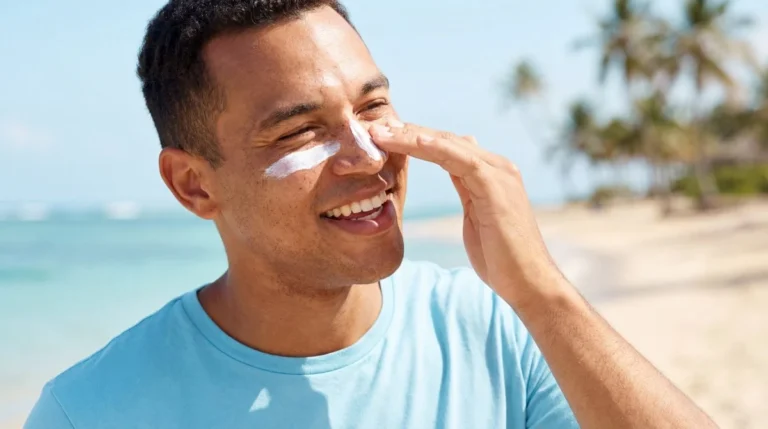
- The best sunscreen for men matches your skin type, has broad-spectrum SPF 30 or higher, and is water-resistant if you sweat or swim.
- Apply generously (about 1 shot glass, 1 oz., for the body and 1/4 teaspoon for the face), and don’t forget ears, neck, hairline, and hands.
- Protect your lips with an SPF chapstick.
- Reapply at least every 2 hours, after 80 minutes of swimming or sweating, and right after towel drying.
It’s Saturday morning, and you’ve got a full to-do list: mow the lawn, wash the car, maybe squeeze in nine holes this afternoon. You dig through the garage, find a half-empty bottle of sunscreen from two summers ago, give it a quick shake, and hope for the best.
Sound familiar to you? Plenty of guys treat sunscreen as their second thought, right up until they’re wincing under a T-shirt collar that suddenly feels like sandpaper.
The good news is that finding the best sunscreen for men doesn’t take much effort. It comes down to a few simple habits and knowing what to look for.
Table of Contents
Start with your skin type.
Sunscreen isn’t one-size-fits-all, even if the bottle makes it look that way. If your skin runs oily, a lightweight formula that doesn’t feel greasy will be easier to wear every day.
If it runs dry, you may prefer something that feels a bit more moisturizing. And if your skin is sensitive, mineral sunscreens made with ingredients like zinc oxide are often a gentler pick, since they sit on top of the skin instead of being absorbed.
If you have a beard, don’t skip the skin underneath it. Sunscreen can go on before you head out, and a few extra seconds along the jawline go a long way.
Check the SPF and look for broad-spectrum
SPF measures protection from UVB rays, the ones that cause sunburn. Most experts recommend SPF 30 or higher for everyday use, and SPF 50 gives you a little extra cushion, blocking about 98% of UVB rays when applied correctly.
Just as important, look for the words “broad-spectrum” on the label. That means the sunscreen also helps protect against UVA rays, which are linked to longer-term skin damage. A high SPF alone doesn’t tell you that.
Choose a water-resistant formula
If you sweat through a workout, hit the lake, or work outside all day, water resistance matters. A water-resistant sunscreen is designed to stay on your skin longer when you’re sweating or swimming.
Keep in mind that “water-resistant” doesn’t mean waterproof. Labels will tell you how long the protection holds up, usually 40 or 80 minutes, and you’ll still need to reapply once that time is up.
Apply it generously
This is where most people go wrong. A thin layer just doesn’t deliver the protection printed on the bottle. Here’s a simple guide:
● Use about 1 shot glass (1 oz.) to cover your body.
● Use about 1/4 teaspoon for your face.
● Apply about 15 minutes before heading outside.
● Rub it in until it’s evenly spread, with no streaks.
Then check the spots that tend to get missed:
● Ears
● Back of the neck
● Hairline and part line
● Bald spots or thinning areas (or wear a hat)
● Tops of the hands and feet
Pick a format you’ll actually use
The best sunscreen is the one you’ll really put on. Lotions are great for daily use, sticks are handy for the face and ears, and sprays are a quick option for larger areas like your back, arms, and legs.
If you like sprays, a sport mineral sunscreen spray can be a practical fit for active days. This one is a Zinc Oxide formula with SPF 50 broad-spectrum protection that dries clear, so you’re not walking around with white streaks.
It’s water-resistant for up to 80 minutes, and it’s enriched with electrolytes. It’s also vegan, fragrance-free, and free from parabens and chemical sunscreen active ingredients.
Spray sunscreen has its own technique, so keep these tips in mind:
● Shake well before and during use.
● Hold the bottle 4 to 6 inches from your skin.
● Skip windy conditions, and use it in a well-ventilated area.
● Don’t spray directly onto your face. Spray it on your hands, then apply.
● Rub it in after spraying for even coverage.
It may also stain some fabrics, so keep that in mind around your favorite light-colored shirt.
Don’t forget your lips
Your lips get just as much sun as the rest of your face, and they rarely make it into a sunscreen routine. They’re thinner-skinned and easy to overlook, especially when you’re outside for hours.
An SPF chapstick takes care of that gap and keeps your lips moisturized at the same time. Toss one in your pocket, your truck’s cup holder, your work bag, or your golf bag, and reapply after eating or drinking.
Make reapplying a habit
Even the best sunscreen wears off. Plan to reapply:
● At least every 2 hours
● After 80 minutes of swimming or sweating, or sooner if you can tell it’s worn off
● Immediately after towel drying
It also helps to think about the everyday moments that add up. Your morning commute with the window down, lunch on a patio, coaching your kid’s Saturday game, and a long stretch on the driver’s side of the car all count as sun exposure.
For extra protection, limit time in direct sun between 10 a.m. and 2 p.m. when you can, and add a hat, sunglasses, and long sleeves for long days outside. Sunscreen works best as one piece of the puzzle, not the whole thing.
Add it to your routine
So, back to that Saturday morning. Before you fire up the mower, take an extra minute to check your sunscreen, pick a formula that fits your skin, and cover all the spots you’d usually skip.
It’s a small habit, but it pays off, and it doesn’t take more than a minute once it becomes routine. Your skin will thank you next week, next summer, and even a few decades from now.


