

For the past decade, the 3d printer has become a staple in modern school makerspaces. From elementary schools to university engineering labs, educators have embraced additive manufacturing as a way to teach design thinking and rapid prototyping.
However, if you look at the shelves in most of these classrooms, you will see a sea of grey. Grey frogs, grey molecules, grey geographical terrains.
While the ability to physically hold a data point is revolutionary for students, monochrome printing has a limitation: abstraction. A single-color print relies entirely on geometry to convey information. In complex subjects like biology or chemistry, geometry is only half the story. To truly unlock the potential of visual learning, schools are upgrading to the next generation of hardware: the color 3d printer.
Here is why shifting from monochrome to multi-color isn’t just an aesthetic upgrade—it’s a pedagogical necessity.
Table of Contents
Color is Data, Not Decoration
In a STEM curriculum, color is rarely used just to make things look “pretty.” Color is a coding language. It differentiates systems, identifies elements, and highlights critical changes in data.
When a student looks at a monochrome 3D printed heart, they see a lump of plastic with tubes coming out of it. They have to mentally map the textbook diagram onto the physical object to remember which vessel is the aorta and which is the vena cava.
Print that same heart on a multi-filament machine, and the learning barrier vanishes. You can print oxygenated blood pathways in red and deoxygenated pathways in blue. Suddenly, the object explains itself. The student isn’t just holding a model; they are holding a functioning diagram. This reduces cognitive load and allows students to focus on the function of the anatomy rather than struggling to identify the structure.
Case Study: Chemistry and Geography
The “Color as Data” concept becomes even more critical when we move to the microscopic and the macroscopic scales.
In chemistry, the standard CPK coloring system (black for carbon, white for hydrogen, red for oxygen) is the universal language of molecular modeling. A single-color print of a caffeine molecule is a confusing cluster of spheres. A multi-color print is an instantly satisfying study aid that reinforces the periodic table.
In geography and geology, Topographical maps are notoriously difficult for younger students to interpret. By using a machine capable of swapping filaments, you can print a terrain map where sea level is blue, lowlands are green, and high elevations are white. This tactile, visual reinforcement helps students intuitively grasp concepts like elevation and watershed that flat 2D maps often fail to convey.
The “Engagement” Factor
Beyond the raw data, there is the undeniable factor of student engagement. We live in a high-definition, 4K world. Students are used to vibrant, high-fidelity visuals in their video games and media.
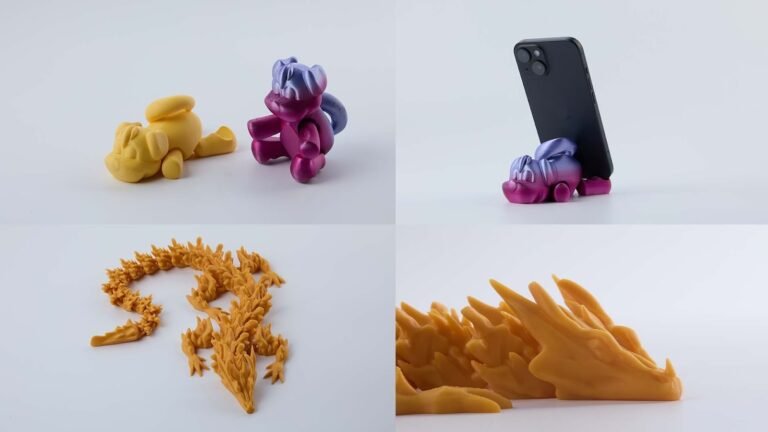
A grey, rough-looking print often feels like a “prototype” or a piece of manufacturing waste. A vibrant, multi-colored object feels like a finished product. When students can design and print objects that look like the toys and tools they buy in stores, their pride in the work skyrockets.
This is particularly effective in younger grades, where “gamifying” the learning process is key. Printing rewards, badges, or personalized learning aids in full color makes the technology feel magical rather than industrial.
Technology That Fits the Classroom
Historically, the barrier to entry for color printing in schools was complexity. Teachers do not have time to unclog nozzles or manually splice filament strands together.
This is why the emergence of independent toolhead printers is a game-changer for education. Unlike older systems that wasted huge amounts of material (and budget) purging colors through a single nozzle, modern independent dual-extrusion (IDEX) systems are efficient and clean.
They allow teachers to run complex multi-material prints—like a rigid bone with a flexible cartilage joint—without becoming full-time printer technicians. The hardware has finally caught up to the ambition of the curriculum.
The Future of the Makerspace
The goal of STEM education is to prepare students for the future workforce. That future is not monochrome. Whether it is medical imaging, architectural modeling, or product design, professional industries rely on color to communicate complex ideas quickly.
By keeping color printing out of the classroom, we are limiting the “vocabulary” students can use to express their ideas. Upgrading to a multi-color ecosystem gives them the full palette they need to visualize the invisible, understand the complex, and truly engage with the material.


