

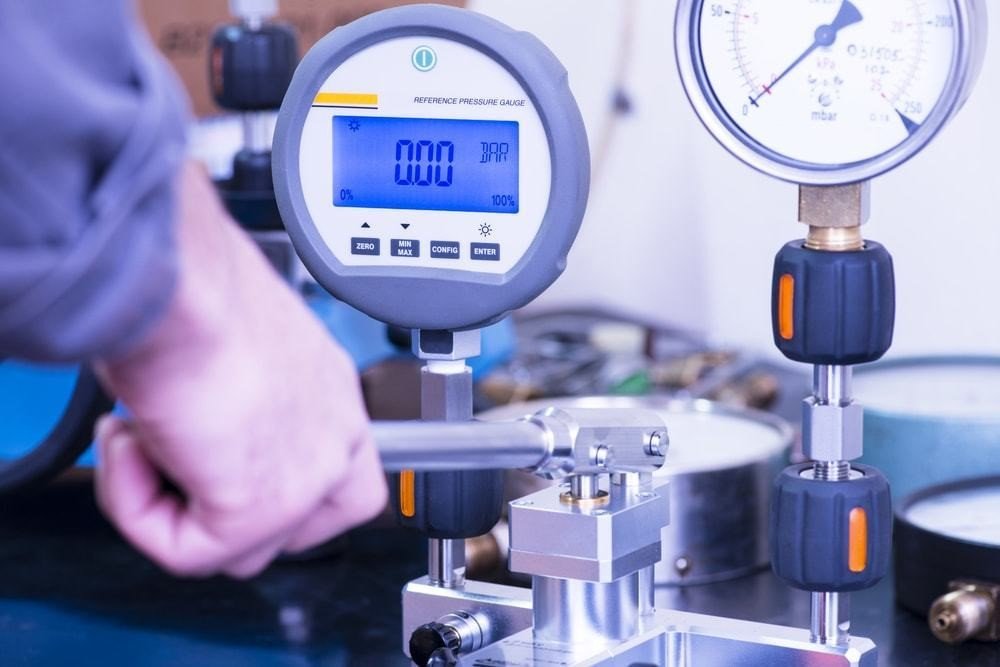
Pressure gauge failures are often caused by one or more of the following fiver reasons: Mechanical vibration, pulsation, extreme temperature, pressure spikes.
Digital pressure gauges are an integral part of a process’s warning system. By constantly measuring pressure, these instruments allow users to see how a process is doing. Gauges are sturdy and can handle challenging conditions. However, even the toughest instruments will experience failure due to the fact that the internal components, like the dial and needle assembly, can be made of plastic which can fracture under pressure. A typical pressure gauge has a glass or quartz dial with a steel needle. Pressure can be applied to the outside of the gauge as well.
Table of Contents
How A Pressure Gauge Works
Mechanical gauges are essentially devices that measure some physical quantity using a pointer. For example, in this case, a mechanical gauge measures the speed of a motor by using a needle to track along the inside of a circular dial.
Mechanical Vibration
Mechanical pressure gauges are made up of two main parts: a stationary part called the housing and a moving part called the indicator. The housing is usually made of metal and contains an electrical connection. The indicator is connected to the housing through a small hole or slot. The indicator moves up and down within the housing, and is attached to the housing by a spring. The spring pushes the indicator up and down with the force of the atmosphere. The pressure in the environment forces the indicator down. As the indicator falls, it closes a switch which turns on the gauge. When the pressure drops, the spring pushes the indicator back up and the switch turns off the gauge.
Pulsation
When a mechanical gauge is used in a process that requires a high level of accuracy, the pressure in the process may vary in a cyclical manner. This is called pulsation. Pulsation is caused by the movement of air and liquids in pipes and vessels. Air can be forced through the system by using fans, pumps, and compressors. Liquids move through pipes and vessels as they are pumped from one place to another. Pulsation can cause mechanical gauges to fail. If a mechanical gauge is placed in a pulsating process, the indicator will move up and down rapidly, but the pointer will only point to a single spot on the dial. Extreme Temperature Mechanical pressure gauges are made of glass or quartz, which are both brittle materials. They are more susceptible to damage at high temperatures than at low temperatures. This is because at higher temperatures, pressure causes the glass or quartz to contract, which in turn causes it to break.
Extreme temperature
High temperature metal parts to expand and contract. For example, when metal expands, it pulls apart and creates a gap between the metal parts. These gaps can allow air to leak into the gauge. As air enters the gauge, it pushes the indicator down and causes the needle to stop moving. Air can also enter the gauge through the holes that connect the indicator to the housing. When air enters the gauge, it causes the indicator to rise, which in turn closes the switch. The switch turns off the gauge.
Pressure spikes
It is very common in many industries. Processes that involve high levels of pressure fluctuation include: Cement Chemical Processing Food Production Pulp and Paper Steel Water Treatment
Examples of Pressure Gauges
Mechanical pressure gauges are used in many industries. They are found in most manufacturing plants, chemical plants, and power plants. The following examples show how mechanical gauges work.
Air Pressure Gauge The air pressure gauge measures the pressure in a pipe. It uses a flexible diaphragm to measure the pressure. The diaphragm is made of a rubber material and is attached to the dial by a small pin. When the pin is pulled out, the diaphragm flexes up and down. The diaphragm is connected to a metal plate inside the housing. As the pressure increases, the diaphragm flexes up and presses against the metal plate. This causes the metal plate to bend, which in turn closes a switch. As the pressure decreases, the diaphragm bends down and pushes the metal plate away from the switch. This opens the switch and turns off the gauge.