

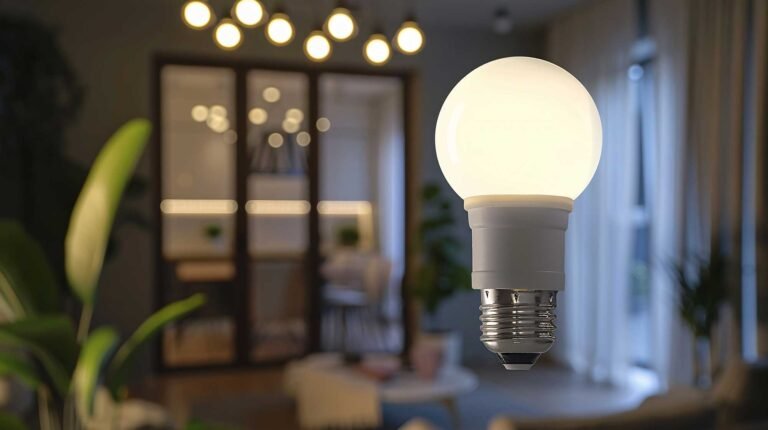
Switching a light bulb sounds like the most straightforward decision in the world. Pick one up, screw it in, done. But there’s a reason so many people end up with a bulb that flickers on a dimmer, a colour that makes the kitchen feel like a hospital corridor, or a fitting that simply doesn’t match what was there before.
Getting energy saving LED light bulbs right isn’t complicated. You just need to know the three or four things that actually matter before you buy anything.
Table of Contents
The Savings Are Real But Only If You Pick the Right Bulb
A 100-watt incandescent bulb replaced with a 12-watt LED delivers the same brightness for 88% less electricity. That’s not a rounding error or a best-case estimate. It’s a genuine transformation of what a light fitting costs to run. Across a whole house, replacing every bulb with a proper LED equivalent cuts lighting bills by somewhere between £65 and £100 a year based on average UK household usage.
The catch is that the savings assume you’ve replaced like for like in terms of brightness, not just swapped in any LED and hoped for the best. Pick a bulb that’s too dim and you’ll end up running extra lamps to compensate. Pick one that’s too harsh and you’ll end up leaving lights off altogether.
Watts and Lumens Are Not the Same Thing
This is where most people go wrong. Wattage measures how much electricity a bulb draws. Lumens measure how much light it actually produces. With incandescent bulbs, wattage was a reasonable proxy for brightness because all incandescent bulbs were similarly inefficient. With LEDs, that relationship breaks down entirely.
A 60-watt incandescent produced around 800 lumens. An LED producing the same 800 lumens uses somewhere between 8 and 10 watts. If you walk into a shop and replace a 60-watt bulb with a 60-watt LED, you’ll end up with something extraordinarily bright and slightly alarming. Match the lumens instead. The packaging on any decent LED will tell you the lumen output and the incandescent equivalent it replaces. Use those numbers.
A practical cheat sheet: 470 lumens replaces a 40-watt bulb, 800 lumens replaces a 60-watt bulb, and 1,520 lumens replaces a 100-watt bulb. Keep those three numbers in your head and most buying decisions become straightforward.
Colour Temperature Does More Than People Realise
Colour temperature is measured in Kelvin and it’s the difference between a room that feels warm and comfortable and one that feels like a staff canteen. Most people never check it, buy whatever’s on the shelf, and then wonder why the room doesn’t feel right.
Warm white sits around 2700K. It’s close to the light that traditional incandescent bulbs produced and it suits living rooms, bedrooms, and dining areas where atmosphere matters more than clinical visibility. Cool white runs from about 4000K to 5000K and is genuinely better for kitchens, bathrooms, and home offices where you need to see clearly and stay alert. Daylight, at 5000K and above, mimics natural light and works well in workshops and utility spaces.
The CRI rating is worth paying attention to too. Colour Rendering Index runs from 0 to 100 and measures how accurately a bulb represents colours compared to natural daylight. Below 80 and your walls look washed out, your food looks odd, and your clothes look different colours in the shop than they do at home. Go for 80 or above as a minimum and above 90 if the room has anything where accurate colour genuinely matters.
A-Rated Bulbs Are a Meaningful Step Up
The UK’s updated energy efficiency labelling introduced A and B ratings that go significantly beyond what standard LEDs deliver. To qualify as A-rated, a bulb needs a luminous efficacy of at least 210 lumens per watt. Your average LED sits well below that. Ultra-efficient A-rated bulbs use around 60% less energy than regular LEDs and have lamp lives running to 50,000 hours and beyond.
At five hours of use per day, a 50,000-hour bulb lasts roughly 27 years. You fit it and essentially never think about it again. The upfront cost is higher. The running cost over that period is considerably lower and the maths works out clearly in favour of the better bulb, particularly in rooms where lights run for several hours daily.
Dimmers Are Still Catching People Out
Old dimmer switches were designed for the relatively high wattage loads that incandescent and halogen bulbs drew. They need a minimum load to work properly. Plug a low-wattage LED into an incompatible dimmer and you get buzzing, flickering, a bulb that won’t dim smoothly, or one that stays faintly on even when the switch is all the way down.
Modern leading-edge dimmers handle LED loads properly but trailing-edge dimmers are specifically designed for them and tend to work more cleanly across a wider range of LED bulbs. The fix isn’t buying a different bulb, it’s checking dimmer compatibility first. Confirm the bulb is explicitly labelled as dimmable, because not all LEDs are, and check what dimmer you have before ordering anything.
Filament LEDs Solve a Problem People Didn’t Know They Had
For years, the one thing LED bulbs genuinely couldn’t do was look like a light source in its own right. Everything pointed downward or outward in a functional direction. Filament LEDs changed that. The glowing filament is visible, the light radiates in all directions, and the warm amber tone they produce at around 2200 to 2400K is something no other LED type replicates.
In pendant fittings, exposed bulb chandeliers, table lamps with translucent shades, and any application where the bulb itself is part of the aesthetic, a filament LED is usually the right answer. They’re not always the most efficient option in their category but they’ve improved significantly and they solve the problem of a fitting that looks wrong with a standard LED inside it.
The Smart Lighting Question
Smart LED bulbs that connect to Alexa, Google Home, or Apple HomeKit have become genuinely practical rather than just impressive to show off. Schedules that switch lights off automatically, motion activation for hallways and bathrooms, and dimming scenes that change the mood of a room without getting up are features that actually get used in day-to-day life.
The energy case for smart bulbs is real too. A bulb that turns off automatically when a room is empty doesn’t run for two hours while everyone’s forgotten it’s on. Over a year across multiple rooms, that accumulates into a meaningful saving on top of the efficiency gains from the LED technology itself.
One room at a time, one bulb swap at a time. The savings are real and they compound faster than most people expect.


