

Optimizing your tech carry is about efficiency and reliability. The days of lugging around a tangled mess of cables and distinct bricks for every gadget are over. Today, a unified power strategy is the hallmark of a seasoned traveler.
By understanding the underlying technology, you can significantly reduce your load while increasing charging speeds. The goal is a setup that is lightweight, powerful, and adaptable to any environment.
Table of Contents
The GaN Technology Shift
The most critical advancement in recent years is the transition from silicon to Gallium Nitride (GaN). This semiconductor allows for higher efficiency and reduced heat dissipation in a much smaller form factor.
Compact Form Factors
When selecting a primary driver for your kit, a usb c charger equipped with GaN is the modern standard. It provides the density required to output high wattage without occupying your entire power strip.
Older adapters were bulky and prone to overheating. In contrast, a best usb-c charger fits easily into a side pocket. This reduction in size is essential for travelers who prioritize a minimalist philosophy without compromising on performance.
Intelligent Power Negotiation
Beyond size, a modern usb c charger handles power negotiation better than legacy bricks. It communicates with your device via Power Delivery (PD) protocols to deliver the exact voltage needed.
This smart regulation is why a generic adapter often fails to match the speed of a specialized usb c charger. It ensures that whether you are charging a watch or a workstation, the device receives safe and optimal current.
Solving the Off-Grid Power Dilemma
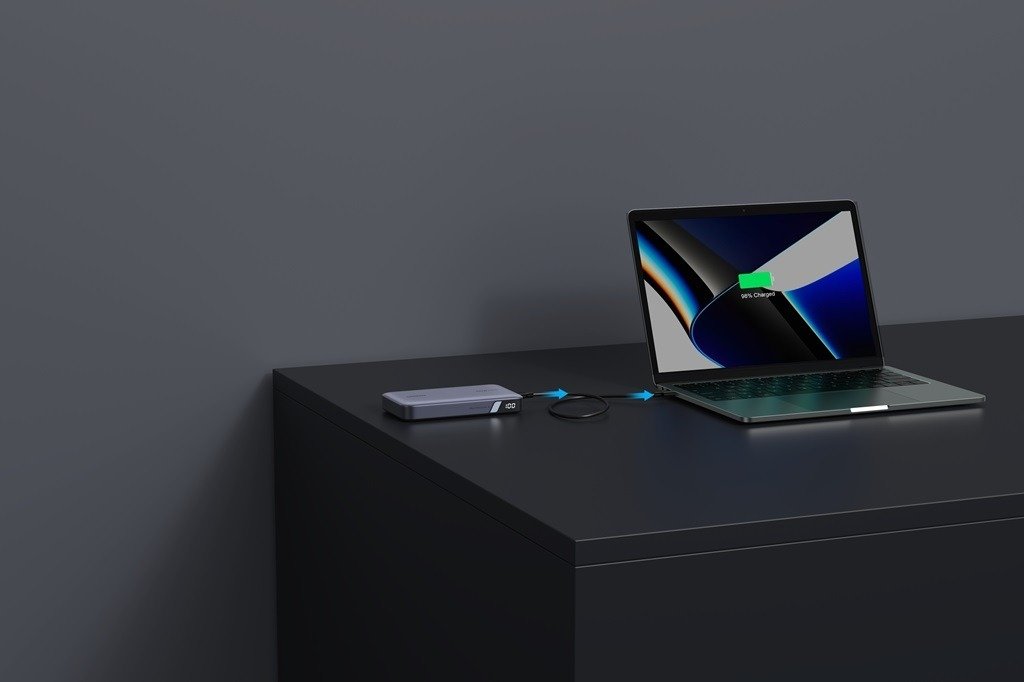
While a compact wall plug covers you at the hotel, transit scenarios present a different challenge. To maintain productivity off-grid, you specifically need a robust power bank for laptop workflows to ensure continuity.
Output and Protocols
Many phone-focused packs top out at lower wattage. For a power bank for laptop use, prioritize USB-C Power Delivery and enough wattage for your laptop’s charging profile.
Look for devices supporting PD 3.0 or PPS standards. Without a dedicated power bank for laptop tasks, your ability to render video or compile code is strictly tethered to wall availability.
Realistic Capacity
For capacity, 20,000mAh is a solid baseline. However, real-world refills depend on watt-hours and conversion losses. A power bank for laptop applications generally provides a partial to near-full top-up for thin-and-light machines rather than a guaranteed full charge.
Despite this, it acts as a critical safety net. It bridges the gap between departure and arrival, keeping your workflow uninterrupted during unexpected airport layovers.
Optimizing for Wireless Ecosystems
Once your heavy-duty power needs are met, you must consider the specific requirements of your smaller devices. A dedicated magsafe charger offers a “snap-and-go” convenience that standard cables cannot match.
The Magnetic Advantage
For users in the Apple ecosystem, the desktop experience is vastly improved by magnetic alignment. Unlike generic wireless pads, an Apple-certified or compatible magsafe charger helps keep alignment consistent.
This mitigates energy loss through heat, which is particularly useful for nightstand setups. The utility of a magsafe charger lies in its ability to turn a flat surface into an active, organized power station without the fuss of plugging in.
Cable Protocols
For devices that do not support a magsafe charger, the cable choice is paramount. A robust usb c charger is only as good as the cable connecting it.
Ensure your cables are rated for the same wattage as your brick to avoid bottlenecks. Using an unrated cable will result in throttled speeds, regardless of whether you are using a premium magsafe charger or a standard cord.
Safety and Thermal Dynamics
High-speed energy transfer generates heat. This is an unavoidable law of physics. However, how that heat is managed differentiates a safe product from a hazard.
Active Protection Systems
Reliable equipment must include active protection systems. Whether it is a wall unit or a power bank for laptop use, the device should have over-current, over-voltage, and short-circuit protection.
These internal fail-safes are non-negotiable. They protect your expensive hardware from spikes and surges that often occur in unstable travel environments.
Continuous Monitoring
Advanced thermal safeguards continuously monitor temperature and can reduce output if conditions exceed safe limits. If a usb c charger exceeds safe operating parameters, it automatically throttles down.
Similarly, a high-density power bank for laptop use requires a sophisticated Battery Management System (BMS). This prevents thermal runaway during rapid discharge cycles, ensuring longevity and user safety.
Conclusion
Building the perfect charging kit requires balancing size, speed, and capacity. Always calculate your total draw; using a 100W usb c charger ensures you have enough headroom to charge a laptop and phone simultaneously without throttling.
By adding a high-output power bank for laptop use, you gain freedom from wall outlets. Finally, integrating a specific magsafe charger streamlines your daily interaction. When these elements work together, you achieve a seamless and portable tech experience.