

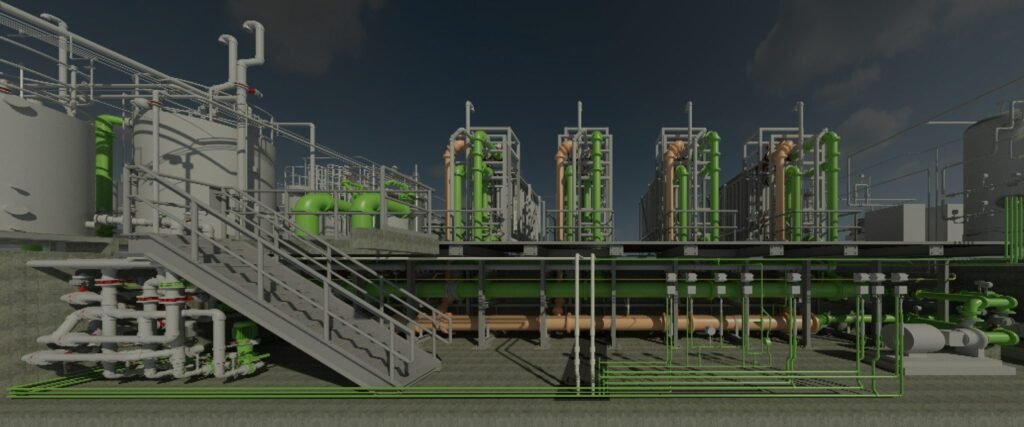
Commercial construction teams rarely lose time because one trade made one isolated mistake. Delays usually come from something more structural: decisions that were not visible early enough.
HVAC is often at the center of that problem. Ductwork, air handling units, VAV boxes, dampers, piping connections, access panels, ceilings, beams, lighting, fire protection, and electrical systems all compete for the same limited space. By the time these conflicts reach the field, they are no longer coordination issues. They are schedule risks.
That is why HVAC BIM services are becoming more than a modeling support function. In commercial construction, they are helping teams move from late-stage clash resolution to earlier risk prevention.
Table of Contents
The Real Problem Is Late Visibility
Traditional drawing reviews can show design intent, but they do not always show buildability. A duct route may look acceptable in 2D until it meets a beam, sprinkler main, cable tray, or ceiling constraint on-site.
This is where Commercial HVAC BIM changes the conversation. Instead of waiting for field teams to interpret overlapping drawings, project stakeholders can review HVAC systems in a coordinated digital environment.
With BIM for HVAC construction, teams can identify:
- Ductwork clashes with structure
- Ceiling clearance issues
- Equipment access limitations
- Conflicts between HVAC, plumbing, electrical, and fire protection systems
- Maintenance and serviceability concerns
- Installation sequencing challenges
The benefit is not just fewer clashes. It is earlier visibility into risks that would otherwise become RFIs, change orders, or rework.
HVAC BIM Turns Coordination Into Risk Control
For years, coordination was treated as a technical step before installation. That view is too limited for today’s commercial projects.
Modern buildings are more system-heavy. Healthcare facilities, data centers, hotels, offices, airports, and mixed-use developments all require tighter mechanical coordination. HVAC systems must support comfort, energy performance, ventilation, life safety, and operational reliability.
That makes HVAC coordination services a risk-control strategy.
A coordinated HVAC model helps teams assess whether the design can actually be built within the available space, budget, and schedule. It gives general contractors, mechanical contractors, engineers, and trade partners a shared basis for decision-making.
Instead of asking, “Where is the clash?” teams can ask better questions:
- Can this route be installed safely?
- Is there enough access for maintenance?
- Will this change affect other trades?
- Can this section support prefabrication?
- Will this layout hold up during construction?
- That shift is where the real value of BIM begins.

From Model Accuracy to Field Confidence
Good HVAC modeling services are not just about creating clean 3D geometry. They are about giving field teams information they can trust.
A coordinated model can support:
- Duct routing and sizing
- AHU, VAV, diffuser, and grille placement
- Hanger and support coordination
- Penetration planning
- Equipment clearance validation
- Sheet metal fabrication planning
- Shop drawing development
- As-built HVAC documentation
When HVAC models are coordinated with architecture, structure, electrical, plumbing, and fire protection systems, installation becomes less dependent on guesswork. Field crews can understand what needs to be installed, where it fits, and how it interacts with adjacent systems.
That confidence matters. Every avoided field adjustment saves time, protects labor productivity, and reduces disruption across trades.
Coordination Meetings Need Model-Based Evidence
Commercial projects do not suffer from a lack of meetings. They suffer when meetings are based on unclear information.
A federated BIM model gives coordination meetings a stronger foundation. Teams can review conflicts visually, assign responsibilities, track decisions, and validate updates before construction begins.
This is especially important for BIM clash detection for HVAC systems in commercial buildings, where small spatial conflicts can create larger downstream consequences.
For example, a duct route that conflicts with a structural beam may require rerouting. That rerouting may affect ceiling height, sprinkler layout, lighting placement, access panels, and fabrication drawings. Without model-based coordination, one issue can quickly become a chain reaction.
With HVAC coordination services, those conflicts can be studied before they affect procurement, fabrication, or installation.
Why HVAC Carries Outsized Coordination Risk
HVAC systems create unique coordination pressure because they occupy significant physical space. Ductwork is not flexible in the same way conduit or small piping can be. Large supply and return ducts need clear routes, smooth transitions, and adequate space for insulation, dampers, hangers, and access.
Mechanical rooms add another layer of complexity. Equipment must be placed with enough clearance for operation, replacement, and maintenance. Poor coordination may not only affect construction; it can affect the building’s long-term usability.
This is why commercial HVAC BIM is especially valuable in projects with dense MEP systems. It supports mechanical coordination, constructability review, building systems integration, and construction sequencing before problems reach the site.
The New Value of HVAC BIM Is Predictability
| Project Challenge | Without BIM | With HVAC BIM Services |
| RFIs | High volume due to unclear coordination | Reduced through early model validation |
| Change Orders | Frequent due to field conflicts | Minimized with preconstruction clash resolution |
| Field Rework | Common due to installation clashes | Significantly reduced with coordinated models |
| Installation Delays | Unpredictable sequencing issues | Improved scheduling and workflow clarity |
| Material Waste | Higher due to rework and redesign | Optimized through accurate HVAC modeling services |
| Trade Conflicts | Reactive, resolved on-site | Proactively addressed through HVAC coordination services |
| Fabrication Errors | Higher due to unclear drawings | Reduced with BIM-driven shop drawings |
| Project Predictability | Low visibility into risks | High predictability with BIM for HVAC construction |
More importantly, teams gain a clearer understanding of what is buildable. That clarity supports better planning, more reliable schedules, and stronger coordination between design and construction.
For mechanical contractors, BIM can improve prefabrication planning. For general contractors, it supports schedule control. For owners, it reduces uncertainty. For design teams, it creates a feedback loop between intent and constructability.
This is why BIM for HVAC construction should not be viewed as a documentation exercise. It is a project delivery tool.
Where HVAC BIM Matters Most
The need for coordinated HVAC modeling becomes sharper in complex commercial environments.
In healthcare facilities, ventilation, pressure relationships, infection control, and maintenance access require careful coordination. In data centers, cooling infrastructure must support performance and uptime. In airports, hotels, and mixed-use developments, high system density leaves little room for field improvisation.
Large office buildings and educational campuses also benefit from HVAC modeling services, especially when phased construction, ceiling coordination, and future maintenance requirements are part of the project scope.
In each case, the same principle applies: the more complex the building, the more expensive late coordination becomes.
Coordination Is Becoming a Preconstruction Discipline
The future of HVAC coordination is not faster clash resolution. It is earlier risk prevention.
Commercial construction projects are becoming denser, more technical, and less forgiving of delays. Teams can no longer afford to discover mechanical conflicts after materials are ordered or crews are mobilized.
HVAC BIM services give project teams a way to bring coordination into preconstruction, where decisions are cheaper, faster, and safer to make. The model becomes more than a digital representation of the building. It becomes a working environment for reducing uncertainty.
That is the real shift. HVAC BIM is not simply improving coordination. It is helping commercial construction teams build with greater confidence before construction begins.