

Formulation issues can be daunting when dealing with products that lose texture or fail to hold their shape. Inconsistent outcomes in either food preparation or product development costs may result in wasting time and resources.
These difficulties can be caused by the selection of an incorrect stabilizing or gelling agent. Kappa Carrageenan is a sure way to go because it has predictable gelation and structural stability, allowing the formula to work as required between manufacturing and consumption.
This article explores Kappa Carrageenan in a clear, practical way. This will cover its basics, structure, usage, and benefits. Towards the conclusion, you will know how this ingredient would resolve your usual formulation’s challenging issues with certainty and precision.
Table of Contents
Kappa Carrageenan Basics
1. Definition and Origin
Kappa Carrageenan is a natural hydrocolloid that is obtained from certain species of red seaweed. It is a part of a larger family of carrageenans, each having different functional properties. Kappa Carrageenan has been particularly appreciated due to its high gelling capacity in the presence of potassium ions.
This ingredient has been proposed in food systems throughout the decades, which is the reason it has a good safety profile and is reliable. In contrast to artificial stabilizers, it is made using a renewable marine resource, which is attractive to manufacturers of clean-label and naturally obtained stabilizers.
Due to its predictable behavior, Kappa Carrageenan is important in products that need structure, clarity, and stability. It can also be efficiently used at low concentration, thus enhancing formulation efficiency.

2. Key Characteristics
Klareg or Kappa Carrageenan is a compound that does not make elastic gels but brittle ones. This quality allows products to hold shape while still delivering a clean bite or cut. The texture is considered to be structured in place of rubbery, which is quite preferable in dairy and dessert preparations.
The other characteristic trait is its reaction with proteins. Kappa Carrageenan is a binding protein present in milk-based systems that prevents separation and improves overall mouthfeel. This interaction enhances consistency throughout storage and consumption.
Clarity is another advantage. Kappa Carrageenan gels are clear, enabling products of aesthetic appearance. This transparency is what makes it different when compared to numerous other thickening agents.
Kappa Carrageenan Structure
1. Molecular Composition
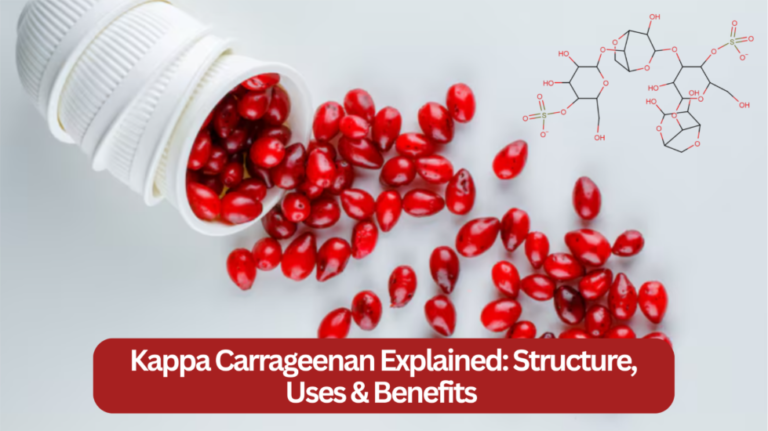
Kappa Carrageenan is made of repeating galactose units in long chains of polysaccharide. These chains have sulfate groups, which are important to the functionality of the ingredients. The number and position of these sulfate groups influence how the polymer interacts with ions and water.
It contains fewer sulfate groups than other forms of carrageenan. This reduced content of sulfates promotes the development of stiffer gels. The structure enables more compact molecular packing of the gel.
Knowledge of this composition would clarify why Kappa Carrageenan acts differently from the lambda or iota carrageenan. Each type offers unique textural outcomes based on structural differences.

2. Gel Formation Mechanism
On dissolving Kappa Carrageenan in hot water, the polymer chains unwind and evenly spread out in the solution. When the mixture becomes cooler, these chains start getting reoriented into helical structures.
These helices are then stabilized by potassium ions, which bind them into a three-dimensional gel network. The process forms a hard and brittle gel with edges. The strength of the gel is directly influenced by the presence and concentration of potassium.
This predictable gelation process allows precise control over texture. By adjusting concentration, temperature, and ion content, formulators can tailor firmness to specific product needs.
Kappa Carrageenan Uses
1. Food and Beverage Applications
Kappa carrageen has multiple applications in the dairy aspects, including chocolate milk, puddings, custards, and processed cheese. Its ability to prevent separation and improve mouthfeel makes it especially valuable in these systems.
It is used in plant-based beverages to suspend the proteins and particles in a homogenous manner. This feature acts as an anti-settling agent and makes the entire process of drinking consistent, not only between the first pour and the last drop.
Their clean gel structure is advantageous to desserts. Products are in shape and offer smooth textures, which increases the look and consumer satisfaction.
2. Non-Food Applications
Beyond food, Kappa Carrageenan is used in pharmaceutical preparations in which stable gels are needed. It promotes regulated texture in topical gels and oral dosage formats.
Its stabilizing properties are also used with personal care products. Toothpaste, lotions, and cosmetic gels benefit from consistent viscosity and structure. The fact that it can be used in various industries proves that this ingredient can be very flexible in terms of texture and stability issues.
Recent research highlights recent progress in carrageenan-based composite films for food packaging applications, demonstrating how carrageenan can be combined with functional materials to improve biodegradable packaging performance and shelf-life protection.
Kappa Carrageenan Benefits
1. Functional Advantages
One of the biggest benefits of Kappa Carrageenan is control. It enables an accurate determination of gel strength, firmness, and clarity. This control will result in stable outcomes in production and storage.
Flexibility is provided by thermal reversibility. Gels melt down when heated and harden when cooled, which facilitates easy processing and rework in case of any necessary changes.
Its effectiveness at low usage levels improves cost efficiency. Small amounts deliver significant functional impact without overwhelming formulations.
2. Safety and Sustainability
Regulatory agencies recognize food-grade Kappa Carrageenan as safe for use. According to scientific reviews, there is no consistent evidence of harm when taken within accepted limits.
Sustainably, seaweed farming does not need much land, water, or fertilizers. This renders production of carrageenan environmentally friendly as compared to various land crops. The trio of safety, sustainability, and performance is the reason why Kappa Carrageenan is a confident ingredient around the globe.
Conclusion
Kappa Carrageenan offers a reliable solution to common texture and stability challenges. It is useful in food and non-food in its natural form due to its excellent gelling properties and predictability. The knowledge of its fundamentals will assist in the elimination of the guesswork in formulation.
This is associated with its distinct molecular structure that allows it to create hard, transparent gels and react well with proteins. These characteristics translate into better product quality, consistency, and shelf stability when applied correctly.
Informed use of Kappa Carrageenan leads to better results, and this is the key takeaway from this article. With your formulation objectives, you can efficiently and confidently develop stable, attractive products by aligning their properties to your objectives.


