

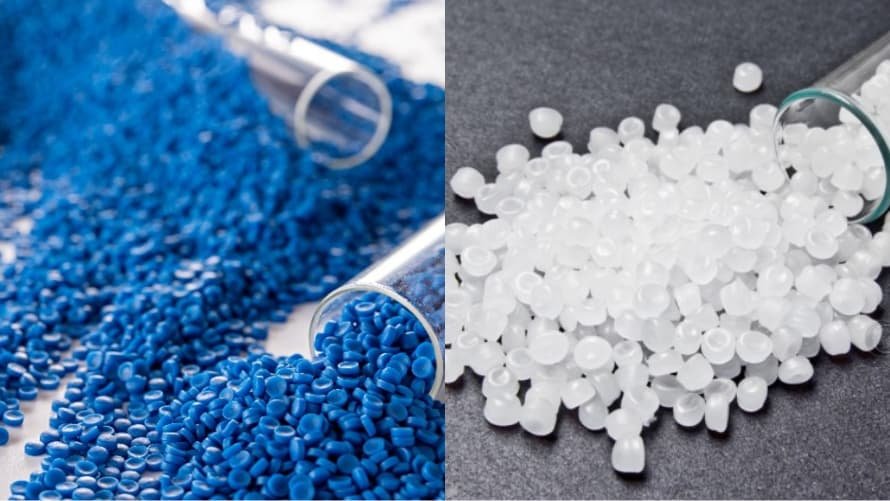
Flexible packaging lines are designed around balance. Film strength, seal integrity, clarity, run speed, and waste control all need to align for operations to remain predictable. When material selection is treated as a purely technical or cost-driven decision, that balance is often disrupted. Polymers that look similar on paper can behave very differently once they enter real production environments.
LDPE, HDPE, and LLDPE are frequently grouped together because they belong to the same polyethylene family. In practice, each behaves differently during extrusion, conversion, sealing, and handling. Understanding these differences is essential for selecting the right material for flexible packaging applications where consistency matters as much as output.
This comparison focuses on how each polymer performs on the production floor rather than how it is marketed or specified.
Table of Contents
How polymer structure influences flexible packaging behavior
All polyethylene materials share a common chemical backbone, but their molecular structure differs in ways that directly affect processing and performance. Branching, density, and molecular arrangement determine how a polymer melts, flows, cools, and bonds.
A ldpe pellets guide is often useful at this stage because LDPE sits at the softer, more forgiving end of the polyethylene spectrum. Comparing it to HDPE and LLDPE highlights why material choice is less about category labels and more about operational fit.
Why structure matters more than labels
Polymers behave according to structure, not name.
- Branching affects flexibility and melt flow
- Density influences stiffness and opacity
- Molecular distribution impacts sealing and toughness
These factors define how well a material supports flexible packaging requirements.
LDPE: flexibility and processing tolerance
Low-density polyethylene is characterized by a highly branched molecular structure. This branching prevents tight molecular packing, resulting in a softer, more flexible material that melts and flows smoothly.
In flexible packaging, LDPE is often valued for its forgiving processing behavior and wide operating window.
Operational strengths of LDPE in packaging lines
LDPE supports stability under varied conditions.
- Smooth melt flow across dies
- Broad sealing window
- Consistent film formation
These characteristics reduce adjustment frequency and operator intervention.
Where LDPE performs best
LDPE is well suited for applications that prioritize flexibility and sealing reliability.
- Bags and liners
- Pouches requiring reliable seals
- Packaging with variable line speeds
Its tolerance makes it easier to maintain consistent output.
HDPE: stiffness and structural integrity
High-density polyethylene has a more linear molecular structure with minimal branching. This allows molecules to pack tightly, increasing stiffness and strength but reducing flexibility.
In flexible packaging contexts, HDPE behaves less forgivingly than LDPE.
How HDPE changes line behavior
HDPE introduces tighter control requirements.
- Higher stiffness reduces film flexibility
- Narrower sealing window
- Greater sensitivity to temperature variation
While strong, HDPE demands more precise process control.
Where HDPE fits in flexible packaging
HDPE is often selected when structure is prioritized over softness.
- Thin grocery-style bags
- Applications requiring rigidity
- Lightweight packaging with strength focus
Its use requires disciplined parameter control.
LLDPE: toughness through linear flexibility
Linear low-density polyethylene sits between LDPE and HDPE in structure. It is linear like HDPE but incorporates short-chain branching that improves toughness and puncture resistance.
LLDPE is often used to enhance mechanical performance while retaining some flexibility.
How LLDPE behaves on the production floor
LLDPE introduces trade-offs.
- Higher toughness than LDPE
- Narrower sealing window
- Greater sensitivity to process variation
Lines using LLDPE often require more consistent material quality and tighter control.
Typical use cases for LLDPE
LLDPE is commonly used when durability matters.
- Stretch films
- Heavy-duty packaging
- Applications exposed to handling stress
It performs best in well-controlled environments.
Melt behavior comparison across polymers
Melt behavior defines how easily a polymer flows and how stable that flow remains over time. Small differences here have large downstream effects.
LDPE melt behavior
LDPE melts smoothly and flows evenly.
- Stable viscosity
- Forgiving to temperature variation
- Easy startup and changeover
This supports consistent film thickness.
HDPE melt behavior
HDPE exhibits more rigid flow characteristics.
- Higher viscosity sensitivity
- Less forgiving during transitions
- Greater risk of uneven distribution
Flow instability becomes more likely without precise tuning.
LLDPE melt behavior
LLDPE balances flow and strength.
- Stable under controlled conditions
- More shear-sensitive than LDPE
- Requires consistent feedstock quality
Process discipline becomes more important.
Sealing behavior and window width
Seal integrity is critical in flexible packaging. The effective sealing window determines how tolerant the line is to variation.
LDPE sealing characteristics
LDPE provides a wide and forgiving seal range.
- Reliable bonding at varied temperatures
- Reduced seal failures
- Greater tolerance to line speed changes
This reliability simplifies quality assurance.
HDPE sealing characteristics
HDPE seals require precision.
- Narrow temperature range
- Higher risk of incomplete bonding
- Increased sensitivity to cooling behavior
Seal consistency demands tighter control.
LLDPE sealing characteristics
LLDPE seals offer strength but less tolerance.
- Strong seals when conditions are right
- Narrower window than LDPE
- Greater variation across batches
Consistency depends heavily on material quality.
Film clarity and appearance
Visual appearance affects both customer perception and inspection efficiency.
LDPE appearance
LDPE films are generally clear and uniform.
- Smooth surface finish
- Consistent gloss
- Fewer visual defects
This supports aesthetic packaging needs.
HDPE appearance
HDPE films tend to be more opaque.
- Higher stiffness reduces clarity
- Surface variation more visible
- Aesthetic limitations for certain uses
Appearance may limit application suitability.
LLDPE appearance
LLDPE appearance varies by formulation.
- Moderate clarity
- Surface defects more noticeable
- Greater dependence on processing conditions
Visual consistency requires attention.
Impact on equipment wear and maintenance
Different polymers stress equipment differently.
LDPE equipment interaction
LDPE tends to be gentler on machinery.
- Lower shear stress
- Reduced die buildup
- More uniform wear
Maintenance intervals remain predictable.
HDPE equipment interaction
HDPE introduces higher mechanical stress.
- Greater pressure variation
- Increased wear in specific zones
- More frequent cleaning
Equipment management becomes more involved.
LLDPE equipment interaction
LLDPE stress depends on consistency.
- Uneven wear if quality varies
- Higher sensitivity to contamination
- Greater need for monitoring
Consistency mitigates these risks.
Scrap generation and process stability
Material choice influences waste rates.
LDPE scrap behavior
LDPE supports lower scrap rates.
- Stable startup behavior
- Fewer edge defects
- Reduced adjustment waste
This improves yield over time.
HDPE scrap behavior
HDPE scrap rises with variability.
- Narrow windows increase rejection risk
- Startup waste is more likely
- Adjustment cycles increase waste
Efficiency depends on discipline.
LLDPE scrap behavior
LLDPE scrap varies by control quality.
- High yields under stable conditions
- Rapid waste increase with variability
- Strong batch dependence
Material quality becomes critical.
Cost considerations beyond material pricing
Procurement cost is only one part of total material impact.
Hidden operational costs
Material behavior affects:
- Downtime
- Scrap and rework
- Labor intervention
- Maintenance frequency
Lower-cost material can raise total operating expense.
Polymer behavior in technical context
The differences between LDPE, HDPE, and LLDPE originate in molecular structure and density. A general explanation of polyethylene types and how structural variations affect properties is outlined in Wikipedia’s article on polyethylene, which explains why branching and density influence flexibility, strength, and processing behavior.
This context clarifies why materials within the same family behave so differently on packaging lines.
Choosing the right polymer for flexible packaging
No polymer is universally better. The correct choice depends on what the line needs to do consistently.
When LDPE is the better fit
- Flexible packaging with sealing priority
- Variable line speeds
- Operations valuing stability over stiffness
LDPE supports predictable, forgiving production.
When HDPE makes sense
- Lightweight, rigid packaging
- Tight process control environments
- Applications prioritizing structure
HDPE rewards precision.
When LLDPE is appropriate
- Durability-focused packaging
- Controlled, high-discipline lines
- Consistent material sourcing
LLDPE balances strength and flexibility under the right conditions.
Scaling considerations
As production scales, tolerance for variability shrinks. Materials that require constant correction become limiting factors.
LDPE often scales more smoothly because its processing window absorbs normal variation.
Aligning material choice with operational reality
Material selection should reflect how the line actually operates, not how it is intended to operate. Lines with frequent changeovers, variable demand, or mixed operator experience benefit from more forgiving materials.
Choosing the right polymer reduces correction rather than increasing control burden.
Closing perspective: flexibility is as much operational as material
LDPE, HDPE, and LLDPE each serve important roles in flexible packaging, but they do so under different conditions. LDPE offers processing tolerance and sealing reliability. HDPE delivers structure at the cost of flexibility. LLDPE provides toughness but demands consistency.
Small material differences create large operational consequences because flexible packaging is cumulative and sensitive. Selecting the right polymer is not just a materials decision; it is a production strategy. When material behavior aligns with line reality, packaging operations stabilize, waste falls, and output becomes easier to manage.