

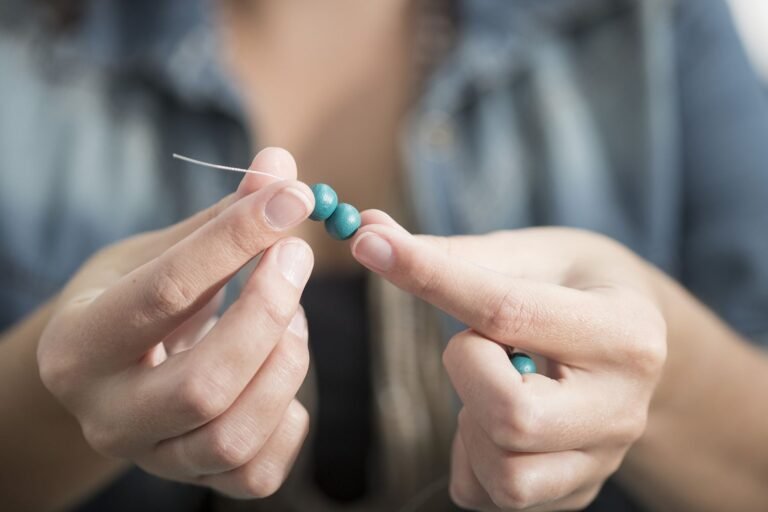
Heavy gemstones create stringing conditions that standard bead cord is not built for. Hard drill hole edges abrade ordinary silk and nylon, and cumulative bead weight stresses clasp terminations beyond what light duty cord can sustain over years of wear. GRIFFIN 1866 Ltd High Performance bead cord addresses both problems. The fibre is ultra-high molecular weight polyethylene (UHMWPE), triple-twisted, 15 times stronger than steel by weight, with a hard specification of 22 N tensile strength at size No. 5 (0.65 mm). It is available in 10 sizes from 0.30mm to 0.90mm. This guide explains the mechanics, gives a cord-to-weight matching chart, and covers the drill hole technique that extends piece longevity.
Table of Contents
The Weight Problem: Why Heavy Beads Fail Standard Cord
A standard 40 bead freshwater pearl necklace weighs roughly 15 to 25 grams. A 40 bead haematite necklace using the same diameter rounds weighs roughly 80 to 100 grams. The cord holding both necklaces carries entirely different loads, yet most makers reach for the same bead cord regardless of material.
Weight creates two failure modes that are specific to heavy gemstones. The first is cumulative tensile stress at the clasp attachment points. Every time the wearer moves, the full weight of the strand creates a brief tension spike at the clasp knots. Over months, those spikes fatigue the cord fibres at the termination points. A cord that reads as adequate at initial construction may be at the limit of its fatigue tolerance after a year of regular wear.
The second failure mode is drill hole abrasion. Dense crystalline gemstones (haematite, lapis lazuli, pyrite, black onyx and similar materials) have drill hole edges that are harder than the cord passing through them. Every movement of the necklace causes the cord to rub against those hard edges. Standard silk thread for jewellery making has poor abrasion resistance compared to high-performance synthetic fibres at equivalent diameters. The abrasion is slow but cumulative.
Tensile Strength Explained in Plain English
Tensile strength is the maximum load a cord can carry before it breaks, expressed per unit of cross-sectional area. The practical number for jewellery makers is simpler: the weight in grams that a single strand of cord can hold before failing.
Standard nylon bead cord at 0.60mm (No. 4 equivalent) typically holds between 1.5 and 3 kg before breaking, depending on manufacturer and construction quality. GRIFFIN NylonPower is engineered for higher tensile strength than standard nylon bead cord, with a hard specification of 4.2 N at size No. 5 (0.65 mm). For most pearl and light gemstone work, either is adequate.
For heavy gemstones the calculation changes. A 40 bead haematite strand weighing 90 grams creates a clasp point tension load that, under movement, can spike to several times the static weight. A cord rated at 1.5 kg may hold the static load but fail under the dynamic spike. Professional grade bead cord for heavy gemstones needs a safety margin that standard nylon beading thread does not provide.
GRIFFIN High Performance: UHMWPE Specification
GRIFFIN High Performance bead cord is engineered specifically for heavy gemstone and demanding stringing applications. The fibre is ultra-high molecular weight polyethylene (UHMWPE), the same fibre class used in high load technical applications outside jewellery.
Key specifications:
● Weight for weight tensile strength: 15 times stronger than steel. The hard specification: 22 N tensile strength at size No. 5 (0.65 mm). This is the strongest bead stringing cord available at professional jewellery diameters.
● Available in 10 sizes: No. 0 (0.30mm), No. 1 (0.35mm), No. 2 (0.45mm), No. 3 (0.50mm), No. 4 (0.60mm), No. 5 (0.65mm), No. 6 (0.70mm), No. 7 (0.75mm), No. 8 (0.80mm) and No. 10 (0.90mm).
● Triple-twisted construction: the same production method used for GRIFFIN Natural Silk and NylonPower, producing a round, stable cord that holds clean knots.
● Colour: white only. For most heavy gemstone work, the cord runs through opaque bead holes and colour is irrelevant. Where the cord is visible, white is the professional neutral.
● Cannot be broken by hand. A practical indicator of the cord’s tensile performance at its working diameters.
GRIFFIN High Performance is not a general-purpose replacement for Natural Silk or NylonPower. It does not have the natural lustre, knot softness or chemical compatibility with pearl nacre that silk provides. It is the right professional grade bead cord for applications where the gemstone weight and drill hole abrasion conditions exceed what other cords handle reliably.
Matching Cord to Gem Weight
The chart below matches gemstone material to recommended GRIFFIN cord specification. Specific gravity values are approximate for standard commercial grades.
| Gemstone | Approx. Specific Gravity | Weight per 8mm bead | Recommended GRIFFIN Cord |
| Freshwater pearl | 2.6 to 2.8 | 0.4 to 0.5 g | Natural Silk No. 6 to No. 8 |
| Rose quartz | 2.6 | 0.7 g | Natural Silk or NylonPower No. 6 to No. 8 |
| Amethyst | 2.65 | 0.7 g | Natural Silk or NylonPower No. 6 to No. 8 |
| Lapis lazuli | 2.7 to 2.9 | 0.8 to 0.9 g | High Performance No. 6 to No. 8 |
| Turquoise | 2.6 to 2.9 | 0.7 to 0.8 g | NylonPower or High Performance No. 6 to No. 8 |
| Black onyx | 2.6 | 0.7 g | NylonPower No. 6 to No. 8 |
| Tiger’s eye | 2.6 to 2.7 | 0.7 g | NylonPower or High Performance No. 6 to No. 8 |
| Haematite | 4.9 to 5.3 | 1.3 to 1.5 g | High Performance No. 6 to No. 8 |
| Pyrite | 4.9 to 5.2 | 1.3 to 1.4 g | High Performance No. 6 to No. 8 |
For a 40 bead strand of 8mm haematite, total strand weight is roughly 52 to 60 grams. Under dynamic movement conditions, the tension at the clasp can reach 3 to 5 times the static weight. GRIFFIN High Performance at No. 6 (0.70mm) provides the required safety margin at this load with significant headroom. Standard nylon beading thread does not.
Drill-Hole Diameter Tricks
The drill hole is more than a passage for the cord. It is the primary abrasion surface for whatever cord runs through it. Managing the drill hole geometry reduces cord wear independently of cord strength.
Three techniques matter here.
Reaming. New gemstone beads often have sharp, rough drill hole edges from the drilling process. Passing a fine bead reamer through the hole before stringing smooths the entry edges, reducing the abrasive cutting action on the cord. Adds less than a minute per bead and measurably extends cord life in hard gemstone applications.
Drilling direction awareness. Gemstone beads are typically drilled from both ends to meet in the middle, creating a slight internal ridge at the meeting point. That ridge is the highest friction point inside the drill hole. When stringing, confirm the cord passes through the full hole length smoothly. If it catches internally, the ridge may need light reaming.
Knot positioning at hard edges. When knotting between beads, the knot should seat flush against the bead face on the cord side, not get pulled into the drill hole opening. A knot forced into the hole entrance creates a compressed friction point at the hardest edge location. Use GRIFFIN Knotting Tweezers to control knot placement precisely.
Designer Case Studies: Lapis, Turquoise, Onyx
Three materials illustrate the range of heavy gemstone considerations.
Lapis lazuli. Specific gravity roughly 2.7 to 2.9. The blue pigment (lazurite) gives lapis its colour but also creates a somewhat friable internal structure in lower-grade material. Drill holes in commercial lapis can have slightly rough internal surfaces. GRIFFIN High Performance at No. 6 to No. 8 is the right specification. Knotting between every bead with GRIFFIN Bead Cord Glue at clasp terminations gives both the separation protection and the termination security the material needs. Expected service life: substantially longer service life than standard nylon for the same gemstone categories.
Turquoise. Specific gravity roughly 2.6 to 2.9, with stabilised commercial turquoise often heavier due to resin treatment. Drill holes are typically well-finished in commercial grades. The primary concern is total strand weight in longer necklace formats. GRIFFIN NylonPower or High Performance at No. 6 to No. 8 depending on individual bead weight assessment. Pre-reaming is usually not needed for stabilised turquoise.
Black onyx. Specific gravity is roughly 2.6. Onyx is a microcrystalline form of quartz and takes an excellent drill finish. The drill hole edges are typically smooth, making it one of the more cord-friendly hard stones. GRIFFIN NylonPower provides adequate tensile strength for most onyx strand weights. High Performance is the specification for longer strands (over 50 beads) or larger diameter beads (10mm and above) where the combined weight creates significant clasp-point stress.
Long-Term Wear Testing
Professional grade bead cord for heavy gemstones is not validated by how it behaves at completion. It is validated by how it behaves after a year of real wear.
The predictors of long-term performance are tensile strength relative to the strand weight under dynamic conditions, abrasion resistance at the drill hole friction surfaces, and termination security at the clasp attachment knots. GRIFFIN High Performance addresses all three: the fibre strength provides the tensile margin, the synthetic composition resists abrasion better than organic fibres, and GRIFFIN Bead Cord Glue at the clasp knots provides locked terminations that do not loosen under sustained use.
The practical restring recommendation for heavy gemstone strands: inspect annually by holding the strand horizontally in both hands and looking at the cord at the drill hole entry points under good light. Any cord thinning, discolouration or visible flattening at entry points means the strand should be restrung before wear is resumed. On High Performance, regular-wear heavy gemstone strands deliver substantially longer service life than the same strands strung on standard nylon beading thread.
Glossary
Tensile strength: the maximum load a cord carries before it breaks. For bead cord, expressed in newtons (N) at a stated diameter. GRIFFIN High Performance is rated to 22 N at size No. 5 (0.65 mm). NylonPower is rated to 4.2 N at the same size.
UHMWPE: ultra-high molecular weight polyethylene. The fibre class used in GRIFFIN High Performance bead cord. Engineered for very high tensile strength at fine diameters.
Specific gravity: a unitless ratio of a material’s density to water. A haematite specific gravity of 5.0 means a haematite bead is roughly twice as heavy as a freshwater pearl bead of the same size.
Drill hole abrasion: the slow cutting action that hard bead edges exert on cord during wear. The dominant failure mode for heavy gemstone strands strung on the wrong cord.
Knot tension: the firmness with which an inter-bead knot closes. Too loose, the knot shifts; too tight, the cord at the knot is structurally compromised. Firm and flush is the target.
Key Takeaways
Heavy gemstones create two specific failure conditions for standard bead cord: cumulative tensile stress at clasp points, and drill hole abrasion. Standard silk and nylon beading thread are not engineered to handle either condition reliably over years of wear.
GRIFFIN High Performance is the professional grade bead cord specification for haematite, lapis lazuli, pyrite and similar dense, hard-edged materials.
Pre-reaming drill holes before stringing reduces abrasive edge sharpness and measurably extends cord life in hard gemstone applications.
GRIFFIN Bead Cord Glue at clasp attachment knots is non-negotiable for heavy gemstone strands. The dynamic tension spikes at clasp points need locked terminations rather than firm knots.
Expected service life: heavy gemstone strands strung on GRIFFIN High Performance deliver substantially longer service life than the same strands strung on standard nylon beading thread.
Related GRIFFIN reading
● 100% Natural Silk bead cord: griffin1866store.com/collections/natural-silk
● NylonPower bead cord: griffin1866store.com/collections/nylonpower
● High Performance bead cord: griffin1866store.com/collections/high-performance
● Knotting Tweezers and finishing tools: griffin1866store.com/collections/tools
Frequently Asked Questions
Q. What is the strongest bead stringing cord available?
A. GRIFFIN High Performance bead cord. The fibre is ultra-high molecular weight polyethylene (UHMWPE), triple-twisted, with a hard specification of 22 N tensile strength at size No. 5 (0.65 mm). Available in 10 sizes from No. 0 (0.30mm) to No. 10 (0.90mm). It cannot be broken by hand. It is the right professional grade bead cord for heavy gemstone applications where no other cord provides adequate long-term security.
Q. Can I use GRIFFIN Natural Silk for lapis lazuli beads?
A. Natural Silk is an organic fibre with moderate abrasion resistance. For lapis lazuli, which has hard drill hole edges and above-average specific gravity, GRIFFIN High Performance is the recommended specification. Natural Silk is appropriate for pearl knotting and light to medium gemstone work where drill hole abrasion conditions are less severe.
Q. What does ‘stronger than steel’ mean for jewellery making?
A. GRIFFIN High Performance bead cord has a strength to weight ratio that, weight for weight, exceeds steel. In practical terms: a single strand of GRIFFIN High Performance at 0.70mm (No. 6) carries loads that would need significantly heavier standard materials to match. The hard specification at size No. 5 (0.65 mm) is 22 N, making it the best beading thread available for fine-diameter heavy gemstone work.
Q. Should I use GRIFFIN High Performance for all gemstone jewellery?
A. Not necessarily. For lighter gemstones such as rose quartz, amethyst and freshwater pearl, GRIFFIN Natural Silk and NylonPower are the appropriate specifications. High Performance is the right choice specifically for dense, heavy gemstones with hard drill hole edges where the combination of bead weight and abrasion creates conditions beyond what standard cord handles reliably over years of wear.
Q. How often should I restring a haematite necklace?
A. Annual inspection is recommended. Under regular wear conditions (two or three times per week), restring when cord thinning, discolouration or visible flattening appears at drill hole entry points. On GRIFFIN High Performance, a haematite strand delivers substantially longer service life between restrings than the same strand on standard nylon beading thread.
Looking for the right cord for your next strand? Browse the full GRIFFIN bead cord range at griffin1866store.com or request a sample card to test against your bead lot.


