

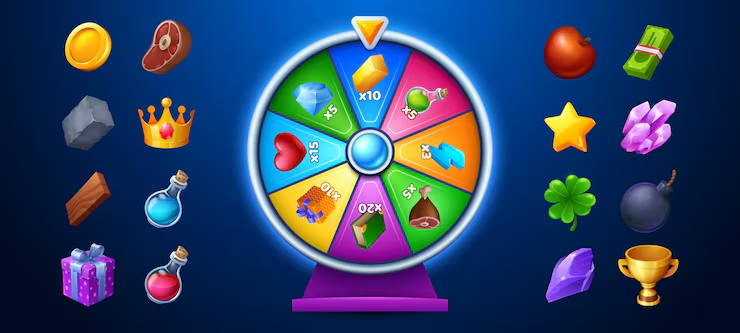
Ever notice how a plain cardboard box becomes infinitely more interesting the moment you don’t know what’s inside? It is a bit ridiculous, really. We are grown adults getting a genuine rush from a digital wheel spinning on a phone screen or a “mystery bundle” in our shopping carts. You’d think we would prefer the logic of knowing exactly what we are paying for, but our brains aren’t always fans of logic. They’re fans of dopamine.
The pull of the unknown is actually hardwired into our biology. It’s not just about the prize itself; it’s about the nerve-wracking gap between the “start” and the “reveal.”
The Science of the “Almost”
Neuroscientists have spent years studying what happens when we encounter randomness. They found that our brains actually release more dopamine during the climb of anticipation than they do when we finally get the reward. If you know you’re getting a ten-dollar bill, your brain gives a polite nod. But give yourself a fifty-fifty shot at either a single dollar or a fifty-dollar jackpot, and suddenly the room feels electric.
There’s a reason spinning wheels, loot boxes, and “mystery prizes” feel weirdly irresistible: it’s all about variable rewards—the same psychological principle that makes a surprise pack more of a punch than certainty. When you don’t know what you’re going to get, your brain stays switched on because the anticipation is basically part of the entertainment.
That’s why everything from mobile games to online quizzes uses reveals, countdowns, and spinning animations: it turns a simple outcome into a mini-event. You can see those same gears turning in classic arcade-style games and in online slots, where the actual spin is arguably the main event. It’s not just the result; it’s the sound effects, those heart-stopping near-misses, and “big win” visuals designed to keep you locked in. Looking at how these games are built is a pretty fascinating window into why randomness feels so addictive, even when the prize isn’t life-changing.
Why We Can’t Look Away
It’s not just the big win that keeps us hooked. It is the “near-miss.” Have you ever watched a digital wheel slow down, ticking right past the jackpot and landing on a dud? That moment feels like a loss, but your brain treats it like a “close success.” It triggers the urge to try just one more time because you feel like you’re “due” for a win. It’s a bit of a trick, of course, but a very effective one.
- The Reveal: The slow peel of a sticker or the flash of a chest opening mimics the physical act of unwrapping a gift.
- The Soundscapes: Bright, upward-spiraling musical notes suggest progress and excitement.
- Social Proof: Seeing others unbox rare items makes us feel like the next big find is just around the corner.
We like to think we are in total control of our choices, but these systems are designed to bypass our “thinking” brain and head straight for the “feeling” brain. Whether it’s a mystery flavor of chips or a loot box in a video game, the psychology remains the same: the mystery is the product.
What’s the weirdest “mystery” item you’ve ever bought? Did the excitement of the reveal live up to the actual prize, or were you just in it for the thrill of the spin? Drop a comment below and let us know if you think these “surprise” mechanics are fun or just a clever way to keep us clicking.


