

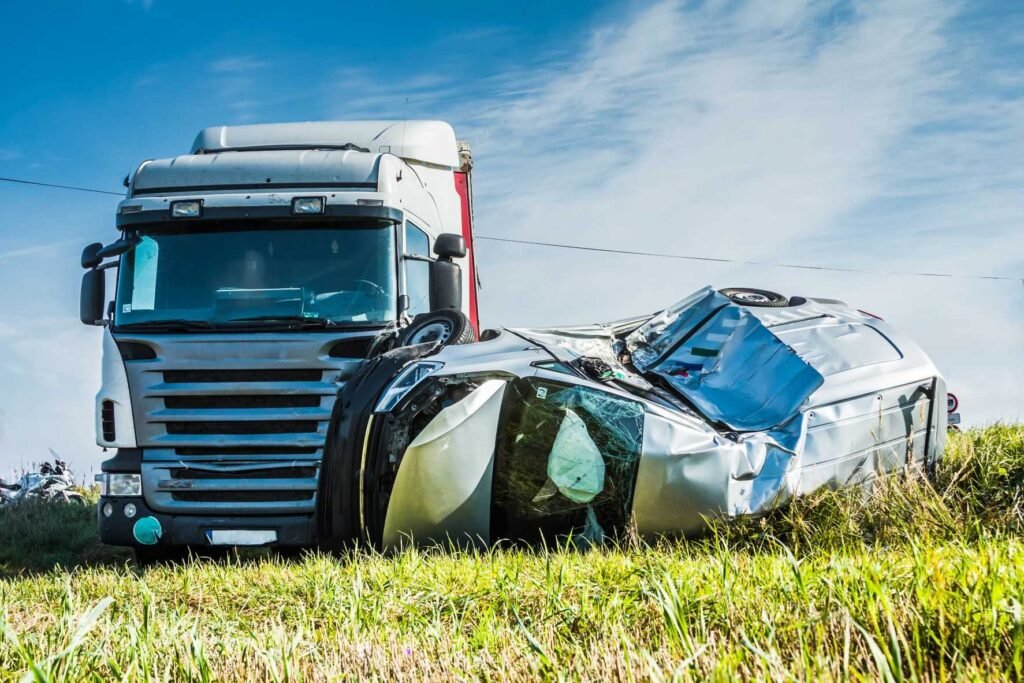
The National Safety Council estimates that 13,100,000 car crashes occur annually in the United States, based on 2024 reports from traffic administration officials, police and other experts. Many injury and fatality accidents involve congested traffic conditions. Victims or their loved ones often hire a truck accident lawyer because of bumper-to-bumper, stop-and-go traffic on one or multiple highway lanes. How does this type of traffic scenario increase the risk of an accident?
Table of Contents
Drivers Must Navigate Smaller Spaces
Both passenger vehicle and truck drivers must maneuver in heavy highway traffic with less space than recommended by safety officials. Instead of maintaining a distance of “car lengths,” each driver on a congested road has only a few feet or even inches between their vehicle and other forms of traffic. Within this limited space, a driver might accidentally crash into a vehicle in front of them or sideswipe a moving or stopped vehicle. They might event hit a pedestrian, bicyclist, motorcycle rider, child or other vulnerable road user.
These accidents occur because a driver or someone else does the following while driving, riding, stopping, or interacting in other ways with traffic:
– Experiences a distraction
– Gauges distances incorrectly
– Fails to see all potential risks
– Makes the wrong decision
– Misses a pull-off break area
– Struggles with nearby elements
Main Causes of Truck Accidents
Crowding on or near one or more congested highways increases the risk of an accident. Heavy traffic forces drivers to interact with more potential dangers than normal. They must also make more spur-of-the-moment decisions. A driver’s ability to safely predict what might happen decreases while they attempt to maintain constant awareness of their surroundings.
Beyond hard-to-maneuver, stop-start traffic, drivers must attempt to not overreact to accidents, construction sites, large and long-haul trucks, traffic jams and other conditions that can result in risky decisions. For example, if they’re not constantly focused and aware of their actions and surroundings, they might jerk the wheel because of an out-of-the-blue horn blast. Also, they might suddenly hit the brakes too hard after another driver makes a no-warning lane change.
Additionally, all drivers face an increased number of blind spots. Passenger vehicle drivers have greater difficulty seeing around big trucks. Truck drivers have more difficulty seeing anything behind and to the sides of their vehicles. Weather conditions compound this problem. During heavy rain, snow or ice conditions, driver visibility decreases, which makes predicting other people’s actions more difficult.
Drivers also struggle with physical road obstacles. They might hit another vehicle while attempting to maneuver around a pothole or miss seeing a deep hole entirely and become stuck. In wet weather, they might hit something in front of or to the side of them because of sliding during a sudden stop mid-traffic, at a signal light, or at a stop sign. Even on a sunny day, a heavy truck can slide easily and needs more room to come to a complete stop.
Mental and Physical Limitations Kick In
All drivers experience non-stop stress in congested traffic. Most people prefer open roads and steady speeds with limited stops. They also like to have control behind the wheel. Bumper-to-bumper highway conditions ramp up the stress and take away their control.
Large and long-haul trucks make many other drivers nervous. They feel intimidated and worried when sharing the road because they fear the horrendous levels of damage that can occur during even a small accident. Truck drivers feel the same. They worry about what they can’t see and the amount of damage they might cause to others. This negative emotional state can lead to bad behaviors and serious mistakes that result in accidents.
Most Americans also keep tight schedules. They pack a day with academic and work tasks, personal errands and group events. When they become “stuck” in congested highway traffic, even if they’re not rushing somewhere, their mood shifts because they’re forced to shift their expectations and possibly make extensive changes to their plans. For example, if an hours-long traffic accident or jam occurs, they might feel like it ruined their entire day.
When a driver experiences anger, fear, frustration, impatience, worry and other strong emotions, they’re more likely to act aggressively on any type of road. They might blare their horn, drive dangerously, or even get out of their vehicle and yell at or attack another driver. Truck drivers can lose their patience and sense of calm and act out as well. That said, these behaviors aren’t the main cause of truck accidents on congested highways.
Truck accidents commonly occur because of distracted driving and fatigue. Drivers experiencing delays often converse with passengers and even people in a nearby vehicle, eat snacks, fiddle with a radio, play games on a phone, and surf the internet. They’re also more likely to fall asleep because of constant physical strain, especially during a long, early morning or late-night work shift or a long-haul journey. Poor decision-making and decreased reaction times increase during these times. A driver might create a dangerous traffic situation or fail to react fast enough to an external danger.
Consequences of Highway Congestion
Since cars and trucks traveling at high speeds can cause more damage than those traveling at reduced speeds, traffic congestion on highways can sometimes make a truck accident less severe. That said, some congested traffic conditions that involve big trucks can actually increase the risk of a horrifying accident.
A semi-truck driver, for example, might accidentally drive over the top of a passenger vehicle. Even at a low speed, the weight of the cab can crush the vehicle underneath it. If a big-rig driver drives too fast while attempting to merge with traffic down an inclined ramp, their truck might plow into the sides of vehicles on the highway. When a passenger vehicle driver drives too close to a long-haul truck, their vehicle might slide partially or fully under the back or side of the trailer.
Local, state and federal traffic officials and others have attempted to reduce incidents by creating truck-only and bike-only lanes. These special highway areas both reduce congestion and remove the largest and heaviest vehicles, as well as the smallest and lightest, from the main flow of traffic. They’ve attempted to add more pull-off zones, improve highway surfaces, increase the number of public transportation options, limit truck access at specific times of known congestion, except for deliveries. They’ve also promoted more safety awareness campaigns.
Sadly, these efforts can’t stop every accident. Congestion alone can even make the risk of a debilitating injury or death higher by delaying police, emergency medical technicians, and firefighters from reaching truck accident victims.
For these reasons, victims and their loved ones need professional help when pursuing an insurance or court claim. They can receive the most support from a local truck driver lawyer like injury attorney Matt Sharp who knows how to handle all the complex elements that can affect the outcome of a case.