

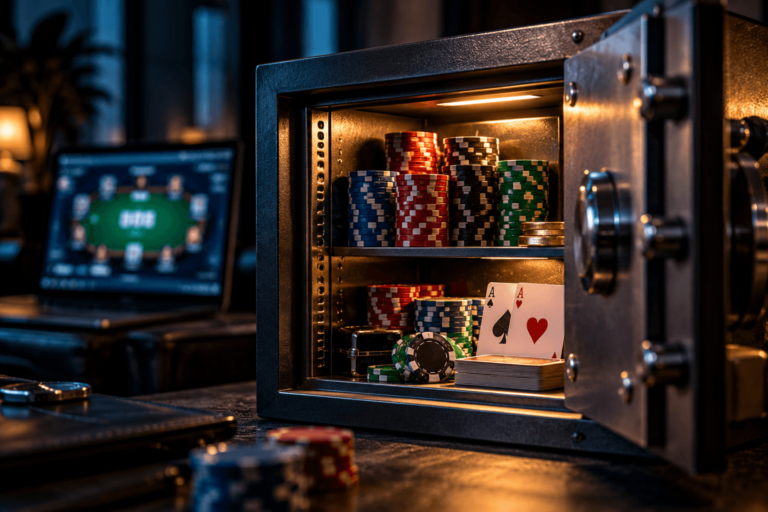
Playing poker online isn’t just cards and chips. You set up an account, hand over personal details, deposit money and later ask to get it back, so a lot of sensitive data keeps traveling between your device and the site.
That’s why online poker security matters more than most players think. Decent sites use encryption and other safeguards to keep your financial and personal information from being intercepted or misused. Encryption is only one piece, though. Payment controls, account verification and secure logins all play a part in keeping your money safe.
Table of Contents
What Poker Site Encryption Actually Does
Poker site encryption converts readable information into encoded data while it travels between a player’s device and the site’s servers. Without the right keys, anything intercepted on the way should be nearly impossible to read. That matters most when you type a password, send personal details or open a payment page. Most modern sites use HTTPS with TLS to set up that encrypted link between your browser and their server.
You can usually spot it by HTTPS in the address bar and the little security icon next to it. It tells you the connection is encrypted, not that the poker operator can be trusted. And encryption only covers data while it’s traveling. Once your information reaches the platform, other safeguards have to take over.
How Encryption Helps Protect Player Funds
A poker balance is connected to an account containing login credentials, transaction history and often identity information. Protecting those details helps reduce the chance of unauthorized access to the funds associated with the account.
Encryption can be used at several stages:
| Area | Purpose |
| Login | Protects credentials while they are transmitted |
| Deposits | Secures payment information sent to the platform |
| Withdrawals | Protects financial and account data during requests |
| Account verification | Helps secure personal documents and details |
| Poker sessions | Protects information exchanged with the platform |
The exact security architecture varies between operators. Encryption does not mean that money itself is somehow encrypted. Instead, it protects the information and communications used to access and manage an account.
Poker Payment Security Goes Beyond Encryption
Depositing and withdrawing money creates another security concern. Poker payment security depends on both the poker operator and the payment systems involved in processing transactions.
A secure connection protects your data while it’s in transit, but many sites go further with payment gateways, transaction monitoring and identity checks. Some ask for extra verification before a withdrawal, especially if you’ve changed account details or requested a large amount.
Online Poker Data Protection
Poker accounts can contain more personal information than players initially realize. Besides an email address and password, an operator may hold a name, date of birth, transaction records, device information and identity documents submitted during verification.
Online poker data protection therefore involves securing both financial and personal information.
Encryption can protect data while it is being transferred and, depending on the operator’s systems, stored information may also be encrypted. Access controls are another important layer. Employees and systems should only have access to data required for their functions.
Players can review the privacy policy of a poker site to understand what information is collected, why it is needed and how it may be handled.
Is Online Poker Safe?
Honestly, is online poker safe doesn’t have one answer, because every platform handles security differently. HTTPS in the address bar is just the starting point, and it doesn’t mean a site is trustworthy.
Before putting money in, spend a couple of minutes checking who owns the site, whether its license holds up, how withdrawals and ID checks work, and what it says about your personal data. A site like BC Poker can show you how one platform lays these things out, but don’t take anyone’s word for it. Verify the security, licensing and payment details with the operator and the regulator directly.
Same goes for promotions. A BC Poker referral bonus can come with eligibility rules or wagering conditions, so read the current terms before you use any invite or offer.
Secure Online Poker Sites Use Multiple Layers
The most effective approach to secure online poker sites is not to rely on a single security feature. Encryption protects communications, but it cannot prevent every type of account problem.
A broader security system may include:
- encrypted connections;
- strong password requirements;
- two-factor authentication where available;
- identity verification;
- withdrawal controls;
- monitoring for unusual login or transaction activity.
These measures address different risks. Two-factor authentication, for example, can make it harder to access an account with a stolen password. Withdrawal checks can provide another barrier if an unauthorized person gets past the login stage.
Security is therefore better understood as several overlapping layers rather than one technology working alone.
What Players Can Do to Improve Poker Account Safety
Operators are responsible for securing their systems, but poker account safety also depends partly on how the account is used.
Reusing the same password across several websites creates unnecessary risk. If credentials are exposed elsewhere, they may be tested against poker accounts. A unique password reduces this problem.
Two-factor authentication should be enabled when the platform provides it. Players should also be cautious with emails or messages asking them to follow a link and log in, particularly when the message creates urgency around a withdrawal, bonus or account restriction.
Using public or unsecured Wi-Fi for financial transactions can introduce additional risks. Keeping the browser, operating system and security software updated also helps close known vulnerabilities.
Encryption Has Limits
Encryption is important, but it cannot protect a player from every threat. An encrypted connection will not help if someone voluntarily gives a password to a phishing site. It also cannot guarantee that an operator manages player funds responsibly.
This distinction matters when evaluating a poker platform. Technical security should be considered alongside licensing, payment policies, account controls and the operator’s terms.
Players should also remember that online poker itself involves financial risk. Security measures can protect an account and its data, but they cannot prevent losses resulting from gameplay.
Staying Safe Before You Deposit
Encryption keeps your login, personal details and payment info private on the way to the poker site, and that counts for a lot. But the padlock in your browser is only part of it. An account stays safe because of what surrounds it: payment controls, ID checks, someone watching for strange activity, and a login that’s hard to crack.
Before you put money in, take a few minutes to see what the site says about security, who licenses it, and how withdrawals are handled. Then do your part with a unique password and two-factor authentication. That alone removes most of the risks you can actually avoid.


