

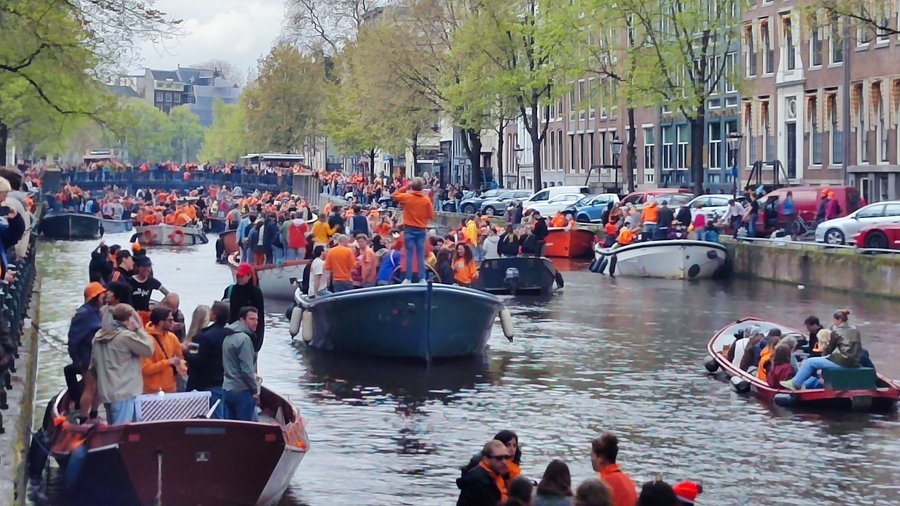
On King’s Day, Amsterdam’s canals turn into a moving festival. Bridges fill with orange crowds, quays become viewing platforms, and boats drift through the canal ring in slow motion. It looks effortless in photos, but the reality is a high-pressure day for the city: heavy crowds, restricted movement in the centre, and extra boating rules designed to prevent accidents.
This guide is a practical, safety-first way to do King’s Day on the canals smartly, whether you plan to watch from land or be on the water.
Start with the reality check: King’s Day adds extra boating rules
King’s Day is not a normal boating day in Amsterdam. I amsterdam explicitly states that additional boating regulations come into force on King’s Day. The key ones that affect most visitors are:
- Boat length limit: boats up to 10 metres may sail through the canals on King’s Day.
- Speed limit: maximum permitted speed is 6 km/h, and if your boat causes excessive wash, you must slow down even further.
- Noise rules: I amsterdam highlights restrictions on amplified sound, with enforcement mentioned.
- Alcohol and control: the official guidance states that alcohol is not permitted for the person in control of a boat.
Even if you are only a passenger, these rules shape the experience. They explain why boats move slowly, why some routes feel congested, and why it helps to plan rather than improvise.
Decide how you want to experience the canals
There are two solid approaches, and the “best” choice depends on your group and tolerance for crowds.
Option 1: watch the canals from land
If your main goal is atmosphere, you can have an excellent canal day without boarding a boat. The trick is to treat it like a viewing event, not a roaming mission.
Smart way to do it:
- Go earlier, when bridges and canal edges are still navigable.
- Pick a wider canal stretch or an area with open space so crowd flow can move around you.
- Choose a meeting point your group can find easily, because separation is common in dense crowds.
This option is also the easiest if you are with kids, anyone with mobility needs, or friends who do not want to commit to a fixed schedule.
Option 2: be on the water
If the canals are the main reason you are coming, a boat can be the most efficient way to experience King’s Day. You swap “constant crowd navigation” for a defined time window, a fixed boarding point, and a more controlled slice of the day.
This matters because I amsterdam warns that King’s Day is one of the busiest days of the year and that public transport in the city centre is affected by restrictions, with routes adapted for crowd movement. When the streets are at peak pressure, having a set plan can feel like a relief.
If you go by boat, choose structure over improvisation
The biggest safety and stress problems happen when people try to “figure it out on the day.” King’s Day is too crowded for that. A structured plan usually includes:
- Clear boarding time and location
- Set duration
- Crew that knows the rules and the day’s traffic flow
If you want to include a subtle option in your blog (without turning the piece into a sales pitch), this is the cleanest way to do it: one link, placed naturally in a planning section.
Amsterdam canal option: Amsterdam King’s Day Boat Party
That page describes different durations (including shared and private formats), which is useful for planning the rest of your day around a fixed window.
Understand what “safe” looks like on the busiest day
King’s Day safety is mostly about preventing a few predictable problems: falls, crush points near bridges, and unstable behaviour on small boats.
Here are the habits that matter most.
Keep your expectations realistic about speed and distance
The water will not feel fast. I amsterdam’s King’s Day rules call out the 6 km/h maximum and the need to reduce speed further if your boat creates wash. Translation: you are not “seeing everything.” You are floating through the party.
Avoid risky movement on board
If you are on a boat:
- Sit down near bridges and tight turns
- Avoid “everyone to one side” photo moments
- Keep walkways clear
- Treat stepping on and off the boat as the highest-risk moment of the day
A lot of King’s Day mishaps come from overconfidence in crowded conditions.
Respect congestion and bottlenecks
Bridges and narrow canal sections create natural bottlenecks. That is why rules about speed and routes exist on the day. If you are watching from land, do not stop in the middle of narrow bridge pathways. If you are on a boat, expect slowdowns near popular crossings.
If you are using your own boat or renting privately, check official rules early
If you are boating independently, do not rely on TikTok advice. Use official guidance.
Waternet manages Amsterdam’s waterways on behalf of the city and water board, and its boating page is the official starting point for things like mooring vignettes and preparation. I amsterdam also points out that Waternet manages the waterways, reinforcing that Waternet is the right authority for rule details.
Two practical reminders:
- If you plan to moor in Amsterdam, you may need the right vignette, and rules vary by location.
- King’s Day is not the day to “wing it” with navigation. Plan where you can and cannot go, and assume special measures may apply.
Treat weather as a safety input, not just a comfort issue
Wind and rain change everything on the canals: slippery steps, colder conditions, and more risk near crowded quays. The simplest smart habit is to check KNMI (the Dutch national meteorological institute) right before the day.
If the forecast looks unstable, build a plan that includes an indoor reset window. King’s Day crowding makes “let’s just find somewhere later” harder than usual.
What to bring for a safer canal day
These are small items that prevent most avoidable discomfort:
- Layers plus a light rain shell
- Closed-toe shoes with grip (wet quays and boat steps are the classic slip point)
- Power bank (you will use maps and messaging more than you expect)
- Minimal valuables (crowds and water is a bad combination)
- A small bag for rubbish if you are on a boat, because clean boating practices matter in the canal environment
Timing strategy: how to avoid the worst of it
If you want the canals to feel fun instead of claustrophobic, timing is your best tool.
- Earlier slots feel easier. Crowds build through late morning into afternoon.
- Pick one anchor experience. A fixed cruise window or a planned canal-viewing window prevents you from chasing the day.
- Do not overschedule travel. I amsterdam notes that public transport routes are adapted on the day and city-centre movement is restricted.
A “day after” recovery idea: see the canals when the city calms down
Many people love King’s Day, and then the next day they want the opposite: quiet, slow sightseeing, and fresh air. If you want to add a relaxed post-King’s Day recommendation that still keeps people on the water, a smoke-friendly cruise can fit well as a recovery activity.
Here is a straightforward option you can link as a calm “day after” experience:
Day-after cruise: Smoke Boat Amsterdam
Positioning matters here: this is not a King’s Day party solution. It is a reset activity for when the city feels noticeably calmer.
A quick safety checklist you can copy into your notes
- Read the official King’s Day boating rules once (length, speed, music).
- Check weather with KNMI the day before and the morning of.
- Choose land viewing or a structured on-water plan, do not improvise in peak crowds.
- Keep your valuables minimal and your shoes practical.
- Treat boarding and bridges as the highest-risk moments, slow down and be patient.