

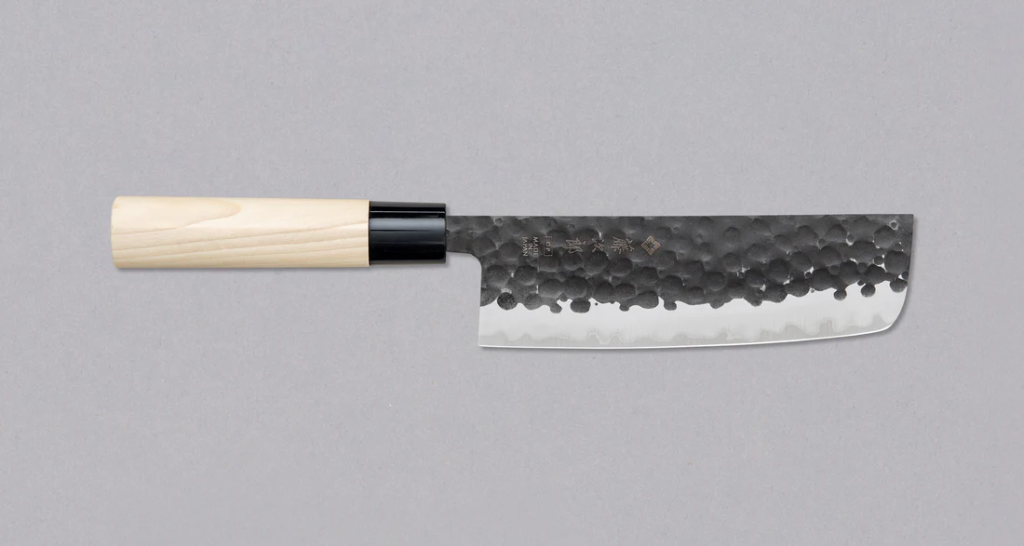
A nakiri knife has become a reference point for cooks who want accurate, repeatable cuts when working with vegetables. Its geometry, weight, and cutting performance make it one of the most efficient tools for anyone who values precision. As interest in traditional Japanese craftsmanship grows, many professionals turn to Japanese knives for their reliability and consistency, and the nakiri stands out as a prime example.
Table of Contents
What a Nakiri Knife Is
“Nakiri” (菜切り) translates to “vegetable cutter,” clearly expressing the knife’s intended purpose. Its rectangular blade, usually between 160 and 180 mm, gives the user a large and stable surface for straight movements along the cutting board. The edge is completely flat, unlike Western chef’s knives that rely on a curved profile for rocking motions. Because the nakiri is double‑beveled, it suits both right‑ and left‑handed users.
Despite its resemblance to a cleaver, it is not designed for bones or heavy chopping tasks. Instead, its construction focuses on uniformity, speed, and clean cuts. When preparing vegetables that must maintain their shape, this knife offers far better control than multipurpose blades.
Why Nakiri Knives Excel at Straight Cuts
Nakiri knives achieve their precision through several deliberate design choices that make straight cuts predictable and easy to repeat.
1. Flat cutting edge
The flat profile ensures that the blade contacts the board across its full length. Unlike curved knives, which require a rocking movement, the nakiri performs best with strict push‑cuts. This avoids leaving uncut strands of vegetables and keeps every slice consistent.
2. Tall, rectangular blade
The height of the blade stabilizes the motion and helps guide the direction of the cut. It also protects the user’s knuckles, enabling efficient repetitive chopping without lifting the knife more than necessary.
3. Thin blade geometry
A thin and razor‑sharp edge reduces resistance, which is essential for delicate vegetables that bruise or lose structure easily. Cucumbers, herbs, zucchinis, and eggplants maintain their texture better when cut with a thin blade that moves cleanly through their fibers.
4. Lightweight, balanced feel
Most nakiri knives balance around the pinch grip area, giving the user control during fast, straight chopping tasks. The design allows for high‑speed meal prep without compromising accuracy.
What a Nakiri Knife Is Best Used For
A Nakiri knife is the preferred tool for cooks who want uniformity in their vegetable preparation. Its predictable profile ensures that each movement can be repeated with the same angle and pressure.
It performs especially well in tasks such as:
- Straight push‑cuts through firm vegetables
- Thin and even slices for salads or garnishes
- Controlled chopping of onions, herbs, and cabbage
- Cutting julienne strips or fine shreds
- Preparing large quantities of vegetables with consistent thickness
Because the knife doesn’t rock, even inexperienced cooks can achieve clean slices with minimal practice.
The Broader Context of Knife Use in the Kitchen
A knife is the most fundamental tool in any kitchen. Selecting the right shape, steel, handle, and edge geometry transforms it into an extension of the cook’s arm. Japanese makers often refer to the ideal connection between user and knife as Jinba Ittai (人馬一体) — the sense of moving as one. When the knife matches the user’s technique, food preparation becomes faster, cleaner, and more intentional.
The nakiri fits into this philosophy perfectly. Its flat edge encourages attention to detail. Its rectangular form keeps cuts straight and steady. Its lightweight design improves rhythm in repetitive tasks. Together, these traits support the idea that better control leads to better food.
Those who enjoy exploring different tools in the Japanese tradition often compare the nakiri with other specialized blades, such as the Bunka knife, which offers versatility for both vegetables and proteins. Understanding how each knife functions helps cooks refine their workflow and choose the right tool for each step.
Sharpedge Shop’s Perspective
Sharpedge Shop has positioned itself as a destination for cooks who want reliable tools and expert guidance. The shop focuses on high‑performance blades and emphasizes the importance of proper sharpness when preparing food. Their approach is educational: helping home cooks and professionals understand how a well‑maintained knife affects flavor, texture, and efficiency.
By highlighting techniques inspired by Jinba Ittai, Sharpedge Shop encourages its community to learn, test, and adopt knives that suit their style of work. Their selection includes dedicated vegetable tools like the nakiri as well as multipurpose designs, giving users access to a wide range of Japanese craftsmanship.
The commitment remains consistent — supporting cooks until they feel complete harmony with their tools and can prepare food with confidence and speed.
Conclusion
The nakiri is engineered to deliver clean, repeatable straight cuts, making it an essential knife for anyone serious about vegetable preparation. Its flat blade, thin geometry, and balanced weight give it advantages that traditional Western knives cannot replicate. For those exploring Japanese craftsmanship, it stands as one of the most effective tools for improving accuracy in the kitchen. For cooks who value precision and reliability, Sharpedge Shop continues to offer resources, expertise, and a carefully selected range of Japanese knives that reflect these principles.