

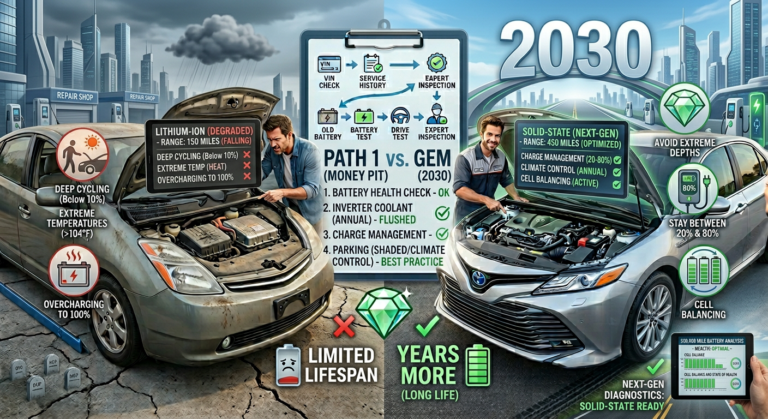
In 2010, the cells inside an electric car cost about $1,100 per kilowatt-hour. Today, the best manufacturers pay under $100 — a 90% collapse in one industrial generation. That price crash, not any single car model, is the real reason electrified vehicles went from science-fair projects to a third of new car sales in some markets. And it’s still moving. The chemistry inside the pack you buy five years from now will likely look different from anything on a dealer lot today.
This article maps the battery landscape as it actually stands: which chemistries power what, why automakers are quietly hedging their bets across three or four different technologies at once, and what all of it means for the person just trying to pick a sensible car. No hype, no doom — just the numbers and trade-offs the industry works with daily.
Table of Contents
Why Chemistry Beats Horsepower in the Electrified Era
For a century, an engine defined a car. Displacement, cylinders, compression ratio — that’s what enthusiasts argued about. In an electrified vehicle, the motor is almost boring. Electric motors are mature, 90%+ efficient, and broadly similar across brands. The pack is where everything interesting happens.
The battery determines the car’s range, its weight (packs run 300–700 kg in full EVs), its charging speed, its cold-weather behavior, its fire risk profile, its resale value, and — at 30–40% of the vehicle’s build cost — its price. Two cars with identical motors but different cell chemistries can behave like entirely different machines. One might charge from 10% to 80% in 18 minutes and shrug off a decade of fast charging; the other might need 45 minutes and degrade twice as fast in hot climates.
That’s why the smartest question you can ask about any electrified car isn’t “how much horsepower?” It’s “what’s in the pack, and how is it managed?”
The Family Tree: Four Chemistries Doing Four Different Jobs
Battery chemistry isn’t a ladder where new simply replaces old. It’s more like a toolbox, where each cell type has carved out the job it does best.
Nickel-metal hydride: the survivor
NiMH should be obsolete on paper — it stores roughly half the energy per kilogram of modern lithium cells. Yet it refuses to die, because it’s extraordinarily durable when cycled gently and it tolerates temperature swings that stress lithium chemistry. That resilience is exactly why millions of Priuses, Camrys, and Corollas still use it. A hybrid car battery only needs to buffer a few kilowatt-hours between the engine and the wheels, cycling shallowly thousands of times a day, and NiMH handles that punishment so well that 250,000-mile original packs are common enough to be unremarkable. For that specific job — small pack, endless shallow cycles, zero drama — the old chemistry often remains the rational engineering choice.
NMC and NCA lithium-ion: the range kings
Nickel-manganese-cobalt (NMC) and nickel-cobalt-aluminum (NCA) cells deliver the highest practical energy density in mass production today — roughly 250–300 Wh/kg at the cell level. That’s why long-range EVs and performance models lean on them. The trade-offs: cobalt and nickel are expensive and ethically complicated to source, and high-nickel cells are the most heat-sensitive of the mainstream options, demanding sophisticated cooling and battery management.
LFP: the workhorse that ate the market
Lithium iron phosphate was dismissed for years as the “cheap Chinese chemistry” — lower density (150–210 Wh/kg), worse cold performance. Then manufacturers solved the packaging problem with cell-to-pack designs, the cost advantage became impossible to ignore, and LFP now powers a huge share of standard-range EVs worldwide. Its party tricks: no cobalt or nickel at all, excellent thermal stability, and cycle life so long (3,000+ full cycles) that many LFP packs will outlast the cars around them. LFP owners can also routinely charge to 100% without guilt — something high-nickel packs punish.
The emerging bench
Semi-solid and solid-state cells promise 400+ Wh/kg and faster charging, with the first limited-production vehicles now appearing, though genuine mass-market scale is still a few years out. Meanwhile, silicon-rich anodes are quietly boosting existing lithium cells by 10–20% without headlines. The pattern to internalize: battery progress arrives as compound interest, roughly 5–8% better every year, not as one dramatic breakthrough.
The Raw-Materials Squeeze — and the Salt-Powered Answer
Here’s the uncomfortable math the industry ran around 2021–2022, when lithium carbonate prices briefly spiked nearly tenfold: if every car sold in 2035 needs a lithium pack, mining has to scale at a pace the sector has never achieved. Prices have since crashed back down, but the scare permanently changed strategy. Nobody serious wants the entire transport system hostage to one element again.
That’s the context that turned an old laboratory curiosity into a funded industrial program. Sodium sits right below lithium on the periodic table, behaves similarly in a cell, and is essentially inexhaustible — it’s a major component of table salt and can be harvested without the geographic chokepoints that complicate lithium supply. A modern sodium-ion battery gives up energy density (currently around 120–200 Wh/kg) but hits back with three genuine advantages: raw materials that cost a fraction of lithium’s, strong performance in freezing temperatures where lithium cells lose 20–40% of their range, and the ability to be safely transported and stored at zero volts. Chinese manufacturers began shipping the first production cells into small city cars and grid-storage projects in 2023–2024, and two-tier packs mixing sodium and lithium cells are already appearing.
Will salt-based cells replace lithium in long-range cars? Almost certainly not this decade — the density gap is real. But for short-range urban vehicles, scooters, backup power, and grid storage, they attack lithium’s cost floor directly. And every gigawatt-hour of storage they absorb is lithium freed up for the vehicles that genuinely need it. That’s how the materials squeeze actually gets solved: not one winner, but load-shedding across chemistries.
How to Read a Battery Spec Sheet Like an Engineer
Shopping for an electrified car? Six things matter far more than the brochure’s headline range figure:
1. Usable vs. gross capacity. A “77 kWh” pack might offer 72 kWh usable — the buffer protects longevity. Bigger buffers generally signal a manufacturer planning for the long haul.
2. Chemistry, stated plainly. If the spec sheet says LFP, you can charge to 100% daily and expect slower degradation. If it’s high-nickel NMC/NCA, plan to live at 80% for daily use. Manufacturers increasingly mix chemistries across trims of the same model — check your specific configuration, not the model name.
3. Peak vs. sustained charging curve. “350 kW charging!” often means 350 kW for ninety seconds. What matters is the 10–80% time and how flat the curve stays. A car that holds 150 kW steadily beats one that spikes to 250 kW and collapses to 70 kW.
4. Thermal management type. Liquid-cooled packs with active thermal preconditioning handle fast charging and hot climates dramatically better than passively cooled ones. This single line item predicts degradation better than almost anything else.
5. Warranty terms, specifically the capacity floor. Most makers guarantee 70% capacity at 8 years/160,000 km. A few guarantee 70–80% for longer. The gap tells you how confident the engineering team is.
6. Heat pump availability. Not a battery spec, technically — but in cold climates, a heat pump preserves 10–20% of winter range that resistive heating would burn. It changes the effective pack size you’re buying.
Spend ten minutes on these six lines and you’ll know more about the car’s long-term ownership reality than most salespeople do.
Myths That Keep Costing People Money
“All batteries degrade fast, so leasing is the only safe option.” Fleet data from hundreds of thousands of vehicles now shows average degradation of roughly 1.8–2.5% per year, decelerating after the first year. Most modern packs will retain 80%+ capacity well past 250,000 km. Pack failures outside recalls are rare and mostly warranty-covered.
“Fast charging destroys the pack.” Frequent DC fast charging adds measurable but modest wear — studies of high-mileage fleet cars show a few extra percentage points of degradation versus slow-charged twins, not the catastrophe forums predict. Heat management matters more than the charger’s badge.
“Winter permanently damages the battery.” Cold temporarily reduces available range, sometimes dramatically, but it doesn’t destroy capacity. If anything, cool climates slow long-term aging. The genuinely harmful combination is fast-charging a frozen pack before it’s preconditioned — which modern cars prevent automatically.
“You should drain to near-zero occasionally to ‘calibrate.'” Deep discharges stress lithium cells; the occasional calibration cycle some manuals suggest exists to recalibrate the gauge, not to help the cells. Once or twice a year is plenty, and never leave the car sitting near empty.
“Replacement will cost more than the car is worth.” Full-pack retail prices look scary, but the real-world repair market has matured fast: module-level repairs, refurbished packs, and third-party specialists routinely fix problems for 20–40% of the headline replacement quote. And because degradation is gradual, most owners sell or trade long before replacement is even a question.
What Packs Actually Cost — Then, Now, and Next
Numbers anchor everything, so here’s the trajectory the industry actually works with:
- 2010: ~$1,100/kWh at cell level. A 60 kWh pack cost more than a whole family car.
- 2015: ~$350/kWh. EVs became plausible but still premium-priced.
- 2020: ~$135/kWh. Price parity with combustion drivetrains appeared on the horizon.
- 2024–2025: best-in-class LFP cells dipped under $60–80/kWh in China; global pack averages sit around $100–115/kWh.
- Late this decade: most analysts project $60–80/kWh pack-level averages, at which point an electric drivetrain is simply cheaper to build than a comparable combustion one.
Translate that to a driveway: a 60 kWh pack that cost $66,000 in materials in 2010 costs roughly $6,000–7,000 today. That 10x collapse is why used electrified cars now hold value better than skeptics expected, why grid-scale storage installations have grown explosively, and why even budget city cars can afford real electric range.
One caveat worth keeping: cheap cells and cheap packs aren’t the same thing. Cooling systems, crash structures, and electronics add cost that falls more slowly. When a bargain-priced vehicle undercuts the market dramatically, the savings sometimes came out of thermal management — the exact component that protects the pack for the second and third owner.
The Ten-Year View: What to Actually Expect
Strip away the press releases and the roadmap looks like this. Lithium chemistries — increasingly LFP at the value end, high-nickel and silicon-enhanced at the premium end — dominate vehicles through 2030. Sodium-based cells absorb the price-sensitive bottom of the market and a growing share of stationary storage. Solid-state arrives first in premium, low-volume applications, the way every battery advance has, and takes most of a decade to trickle down. NiMH keeps doing its quiet, unglamorous job in conventional hybrids until those platforms retire.
No cliff edges. No overnight obsolescence. Compound improvement, roughly 5–8% a year, the way it’s run for thirty years.
For you, the practical conclusion is almost boringly reassuring: there is no “wrong time to buy” hiding around the corner, and waiting for the mythical perfect battery means waiting forever. Buy for the chemistry and thermal management that fit your climate and driving, treat the pack gently, and let the industry’s price curve work in your favor at trade-in time. The battery race rewards informed patience — and punishes only the people who ignore what’s inside the pack entirely.
Frequently Asked Questions
How long do modern EV packs really last? Fleet data points to 15–20 years or 250,000–500,000 km before capacity drops far enough to matter for most drivers. Degradation averages around 2% per year and slows after the first year. Taxi and rideshare vehicles have validated these numbers under brutal real-world use.
Is it bad to charge to 100% every day? Depends entirely on chemistry. LFP packs are designed for it — manufacturers actually recommend regular full charges to keep the gauge accurate. High-nickel packs age faster when parked full, so an 80% daily limit is the standard advice for those.
Why does my range drop so much in winter? Cold electrolyte moves ions sluggishly, and cabin heating draws heavily from the pack. Expect 15–35% less range at freezing temperatures, worse on short trips where the heater never stops working hard. Preconditioning while plugged in claws back a meaningful chunk of it.
Are cheaper chemistries less safe? Often the opposite. Iron-phosphate and salt-based cells are more thermally stable than high-nickel lithium designs and far harder to push into thermal runaway. The cost savings come from raw materials, not from cut safety corners.
What actually happens to old packs? Most get a second life first — grid storage, backup power — because a pack at 70% capacity is still an enormous stationary battery. After that, recyclers now recover 90%+ of the lithium, nickel, and cobalt. The “landfill mountain” scenario has largely failed to materialize because the materials are too valuable to bury.
Should I wait for solid-state before buying? History says no. First solid-state vehicles will be expensive, low-volume, and first-generation technology with first-generation quirks. Today’s mature chemistries are proven, warrantied, and cheaper every year — and your current car keeps aging while you wait.
Does frequent fast charging void the warranty? No mainstream manufacturer voids coverage for using their own supported fast-charging network. Warranties hinge on capacity retention thresholds, not charging habits. Keep records of any dealer battery service, and you’re covered.


