


Gustav Klimt was an Austrian symbolist painter during the 20th Century. Klimt is famous for his paintings, murals, sketches, and other artistic objects. He was the most influenced by the Japanese art style, which makes little use of realism. Klimt’s painting style was slightly stylized; the people did not have the natural form and shape of correct human anatomy. Gustav Klimt’s paintings use minimal tones and shading.
Klimt grew up in a poor household with six siblings, and when he was fourteen years old, he was given a scholarship to a school of arts and crafts. Afterward, he began his interior decorating career. However, after the Death of his father and brother, Gustav developed his art style with symbolist overtones.
Gustav Klimt’s artworks focused on the female body more than any other subject. The women in his paintings are beautiful and often in the nude. For this reason, Gustav Klimt’s art was met with controversy and criticism and considered pornographic. He was the most radical artist of his time. After receiving such harsh feedback, Gustav swore never to accept another public commission.
Table of Contents
The Kiss

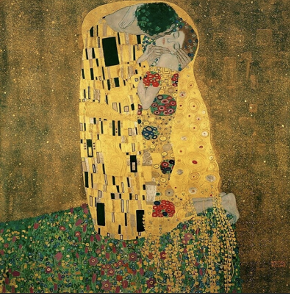
Klimt’s work was known to have themes of love and intimacy. Possibly his most famous work of art: The Kiss is an oil painting with gold leaf, silver, and platinum. Klimt did not travel much, but trips to Venice and Ravenna most likely inspired his gold technique.
The painting shows a couple enjoying a passionate embrace in this monumental Renaissance scene. The lovers appear to be standing in a flowery meadow.
While there is no evidence to prove, many believe the subjects in the painting are Klimt and his friend Emilie Flöge. Art historians have also mentioned that Klimt shows the narrative of Orpheus and Eurydice. The painting resembles the moment when Orpheus turns around to caress Eurydice and loses his love forever.
Whether the story behind the painting is true or not, this picture is a beautiful representation of love and passion. The expression on the woman’s face and how the man is holding her say it all.
Portrait of Adele Bloch-Bauer
The Portrait of Adele Bloch-Bauer, also known as The Lady in Gold, is the final work of Klimt’s golden phase.
Adele Bloch-Bauer, the wife of a Jewish banker Ferdinand Bloch, commissioned Gustav Klimt to paint a portrait of his wife. To prepare for the painting, Gustav drew more than one hundred sketches. The family bought 16 of Gustav Klimt’s drawings of Adele. Art historians and analysts suggest that Adele may have had an affair with Klimt, but there is little proof.
In the portrait, Adele sits on a golden throne in front of a golden starry background. She is dolled up in a tight golden dress with triangles and rectangles, similar to Gustav Klimt’s golden forest print. The painting portrays a dream of sensuality and self-indulgence as Adele embraces her femininity. Critics talking about painter Klimt, described his artwork as “bizarre” and “vulgar” due to the excessive use of gold.
This painting was one of the artworks stolen by Nazis during the Second World War; however, it was later reclaimed by the Bloch-Bauer family.
Three University of Vienna Ceiling Paintings
The University of Vienna commissioned him to paint the ceilings of three faculties.
The first picture to be presented to the Austrian Government was Philosophy. According to Klimt’s description of the painting, the figures on the left depict the beginning of Life, fruition, and decay. The dark figure on the right represents mystery. Emerging below is a figure of light which means knowledge.
Medicine was the second artwork. Again, the painting represents a few stages of life: birth, youth, and Death painted as a newborn infant, a young nude woman, and a skeleton, respectively.
The final piece was Jurisprudence. The painting depicts a condemned man surrounded by three female furies and a sea monster. And in the background, there are three goddesses of Truth, Justice, and Law watch.
These three paintings were the objects of harsh criticism and judgment and were deemed pornographic.
Death and Life
‘Death and Life’ is an incredible oil on canvas painting that took about seven years to complete. Nevertheless, it received first prize in the world exhibitions in Rome. In 1915, after being in five exhibits, Klimt changed the background color from gold to gray.
In the painting, there are people of different ages. Most are young women, but an infant boy and a muscular young man can be seen. The figures are in an area of bright colors, perhaps representing the joy of being alive. They also appear to be embracing one another; this could depict close relationships.
On the left side of the painting, the skeleton represents Death. He is smiling and wearing a cloak with religious symbols. Death gazes upon the people who look unbothered by his presence.
Art analysts thought that since this was one of the last paintings Klimt did, it mirrored his feelings toward dying. Perhaps he was unafraid; hence in the painting, Death seems pleasant.
The Bottom Line
Although Gustav Klimt repeatedly painted nude women, the messages behind most of his work are not vulgar as some thought. Klimt was a brilliant artist despite his personal life choices, and he deserves credit for his talent. His artworks tell stories of love, passion, and being alive. However, we can understand why many deemed him a notorious womanizer.