

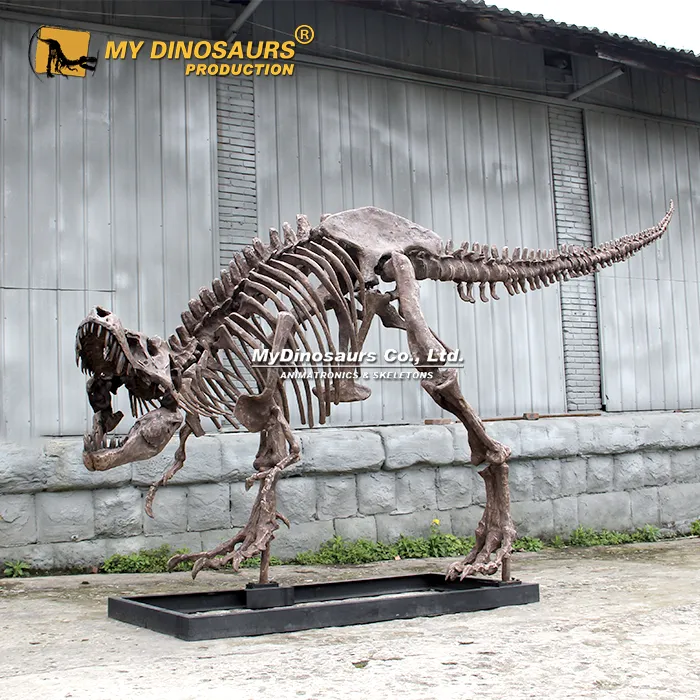
Most people who encounter a towering dinosaur skeleton—whether in a museum, classroom, or collector’s gallery—assume they’re looking at real bones. Yet in today’s market, where a dinosaur skeleton for sale can appear in online listings, exhibitions, and educational catalogs, identifying what’s authentic and what’s a replica has become an increasingly important skill. The difference matters not only because of scientific value but also because of ethical considerations and the practical realities of fossil preservation.
Many individuals exploring this topic share common frustrations: uncertainty about authenticity, confusion around market terminology, and limited knowledge about how fossils are prepared and displayed. Understanding the distinctions helps buyers, students, educators, and enthusiasts avoid misconceptions while appreciating the incredible craft behind both real fossils and their replicas.
Table of Contents
Why Authentic Dinosaur Skeletons Are So Rare
Complete Dinosaur Skeletons Are Extremely Rare
Fully complete dinosaur skeletons are exceptionally uncommon in paleontology. Most discoveries consist of scattered bones or partial remains, often requiring paleontologists to piece together fragments from different individuals of the same species. Even many of the world’s most iconic specimens include reconstructed, mirrored, or scientifically inferred parts. As a result, a perfectly complete, original skeleton is almost never found, and even when discovered, it typically contains unavoidable gaps.
Fully Authentic, Unrestored Skeletons Are Nearly Nonexistent
A dinosaur skeleton composed entirely of authentic, unrestored bones is so rare that it is effectively nonexistent outside of museum or research collections. These specimens hold immense scientific value and are preserved for study. Because fully authentic skeletons are almost never available, a dinosaur skeleton for sale is almost always a replica, making it the only viable option for exhibitions, educational settings, and private collectors seeking a complete and visually accurate representation.
Authentic Fossils Are Fragile and Challenging to Display
Real fossils present significant challenges when it comes to mounting and exhibition. Their mineralized composition makes them extremely heavy, requiring reinforced structural supports and precise installation methods. They are also vulnerable to environmental conditions such as humidity, temperature fluctuations, vibration, and UV light, all of which can cause cracking, crumbling, or other irreversible damage. To prevent deterioration, many original fossils remain in controlled storage or research labs instead of being placed on public display.
Why Replica Skeletons Are Common—and Often Necessary
Replica skeletons play a crucial role in education and exhibition because they offer accurate representations of fossils without the weight or fragility of the real bones. Created by molding original fossils and casting them in materials like fiberglass, resin, or lightweight plastic, they capture fine anatomical details that can be nearly indistinguishable from authentic fossils at a distance.
Replicas also address the problem of incomplete finds, allowing viewers to see a full skeleton even when original fossils are fragmentary. Museums often combine real bones with casts to create composite displays that are both accurate and practical. Because replicas are durable and easy to transport, they are ideal for classrooms, traveling exhibits, visitor centers, and public spaces where original fossils would be too heavy or delicate to use.
How to Evaluate a Dinosaur Skeleton for Sale
When encountering a dinosaur skeleton for sale, it’s important to recognize that the term can refer to authentic fossils, cast replicas, composites, or artistic reconstructions. Determining which one you’re seeing requires attention to a few key details. Provenance is the most critical factor—authentic fossils should include documented excavation records and a clear chain of custody. Material and weight offer additional clues, as real fossils are extremely heavy compared to lightweight resin or fiberglass replicas.
Surface texture can also help: genuine fossils often show natural irregularities or mineral patterns, while replicas may display casting seams or uniform finishes. Finally, be cautious of any complete skeleton; full, authentic dinosaur skeletons are exceptionally rare in private markets and are usually replicas or composites.
To help evaluate what you’re looking at, the following table summarizes key criteria:
| Checkpoint | What to Look For |
| Provenance & Documentation | Detailed excavation records, location, history of ownership. Lack of documentation often indicates a replica. |
| Material & Weight | Authentic fossils are heavy, stone-like; replicas are lightweight resin, fiberglass, or plastic. |
| Surface Texture | Real bones show mineralization and irregularities; casts may have seams or uniform texture. |
| Completeness | Full skeletons are almost always replicas or composites. Authentic full skeletons are extremely rare. |
| Price & Availability | Mass availability or ready-to-ship listings usually indicate replicas; authentic fossils are uncommon and tightly controlled. |
Anyone considering a dinosaur skeleton for sale should ask questions such as: Which bones are original? Which are casts? Has any restoration been done, and how? What materials were used in reconstruction? And crucially, is there verifiable documentation to support authenticity?
The Role of Composite Skeletons
Some displays combine real bones with replica parts to create a complete skeleton. This approach is widely used in museums because it allows institutions to present visually impressive skeletons while protecting fragile fossils. In a composite skeleton, missing bones may be cast from other specimens of the same species, sculpted based on scientific knowledge, or even mirrored from the opposite side of the skeleton. While composite skeletons involve replicas, they still offer valuable insights into an animal’s anatomy and can preserve fragile originals by reducing stress on actual fossil material.
Why Replica Skeletons Matter for Science and Education
Replica skeletons are not just stand-ins for authentic fossils—they serve important scientific, educational, and practical purposes.
- They allow researchers to study bone shapes and structures without risking damage to delicate original fossils.
- Students, educators, and the public gain the same anatomical understanding from replicas when the goal is learning rather than research.
- Replicas make rare specimens accessible worldwide; a single fossil can be digitized, cast, and shared with schools, museums, and exhibitions around the globe.
- They expand paleontological knowledge by enabling institutions in different countries to display otherwise unavailable specimens.
- Replicas have become the standard for most public displays and commercial offerings because they are durable, safe to handle, and practical to mount.
- When a full dinosaur skeleton for sale appears in the market, it is usually a high-quality replica intended for display rather than scientific study.
Setting Realistic Expectations When Buying a Skeleton
For anyone exploring options for a dinosaur skeleton for sale, clear expectations are essential. Authentic fossils are scarce, fragile, and rarely available on the open market. Even partial skeletons can command high prices and require extensive documentation. Replicas, on the other hand, are widely available and serve as accurate, durable representations of original fossils. They are far more practical for display and education, especially in environments where climate control or specialist installation is not feasible.
Buyers should consider their goals carefully. If the purpose is scientific research, original fossils with verified provenance are necessary. For exhibitions, decoration, classroom teaching, or public display, a replica provides a realistic, safe, and visually striking alternative.
Conclusion
Understanding the difference between authentic dinosaur fossils and replicas empowers buyers, educators, and enthusiasts to make informed decisions. Authentic fossils hold immense scientific value but are rare, fragile, and difficult to display. Replicas, meanwhile, offer accessibility, durability, and educational usefulness, often providing the most practical option for anyone encountering a dinosaur skeleton for sale.
By examining provenance, materials, completeness, and documentation, individuals can confidently interpret what they are buying or viewing. Whether one admires a skeleton in a museum or considers adding one to a collection, recognizing these distinctions enriches appreciation for both paleontology and the craftsmanship behind fossil reconstruction.