

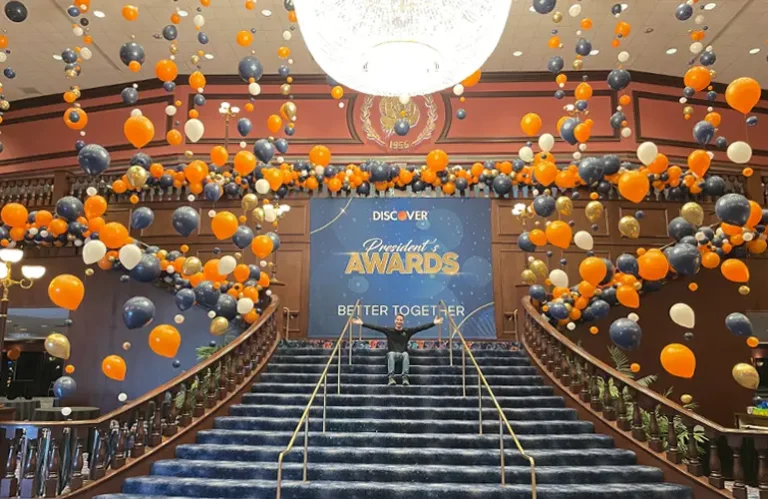
Corporate balloon decor operates under constraints that a birthday party or baby shower never has to think about — brand color accuracy, a specific tone that reads “professional” rather than “playful,” and often a much tighter installation window squeezed between a venue’s other bookings. A design that looks charming and whimsical at a kid’s party can read as oddly unserious at a product launch or shareholder event, which means the same organic, mismatched-cluster style that works beautifully for casual occasions usually gets swapped out for cleaner, more structured arrangements when the audience shifts to clients, executives, or press.
Brand color matching adds a layer of precision that most casual events don’t require. A company’s signature blue isn’t just “blue” — it’s a specific Pantone value that marketing teams notice immediately if the balloon shade skews even slightly warmer or cooler than the actual brand palette. Getting this dialed in usually means sourcing exact-match balloon colors well ahead of the event rather than approximating with whatever shade looks close enough on a supplier’s standard color chart, since a noticeably off-brand color at a corporate event tends to draw more attention than most people expect.
Logo Integration Is Trickier Than It Looks in Reference Photos
Custom logo balloons or arch designs incorporating a company mark seem straightforward until the actual production details surface. Printed balloons require lead time that generic solid-color balloons don’t, since custom printing runs on its own schedule separate from standard inventory, and a company that requests logo balloons two days before an event is often out of luck regardless of budget. This lead time catches event planners off guard more often than it should, especially when a company’s marketing team decides on custom branding relatively late in the planning process.
Placement matters just as much as production. A logo that reads clearly on a step-and-repeat backdrop can get visually lost or distorted if crammed onto a curved arch surface without accounting for how the balloon’s shape will stretch or compress the design. Effective logo integration usually means either building the arch structure around the logo placement from the start, or choosing a simpler standalone logo display — a balloon column or a flat backdrop panel — rather than forcing branding onto a shape that wasn’t really designed to display flat artwork cleanly in the first place.
Installation Windows Are Often Tighter Than Clients Expect
Corporate venues frequently double-book spaces for back-to-back events, leaving decor teams a narrow window to set up, sometimes just an hour or two before doors open to guests. This timeline pressure means corporate balloon decor projects often need more advance coordination with venue staff than a private party would, confirming exact access times, loading dock logistics, and whether other vendors will be working in the same space simultaneously. A decor team that shows up expecting a leisurely four-hour setup window, only to discover they have ninety minutes because the venue’s previous event ran long, ends up rushing through details that deserved more careful attention.
This time crunch also affects design complexity decisions upfront. A highly detailed, multi-color organic installation that would look stunning given a full day to build might simply not be feasible within a compressed corporate setup window, meaning the actual design sometimes needs scaling back to match realistic installation time rather than choosing the most elaborate option first and hoping the schedule works out. Planning corporate balloon decor with this constraint in mind from the start, rather than discovering the time crunch on event day, tends to produce a better finished result than an overly ambitious design forced into an insufficient setup window.


