

Vector stores solve one retrieval problem well: given a query, return semantically similar records. That capability is sufficient when the relevant output is a single stored fact or a ranked list of independent records. It is not sufficient when the answer requires traversing a chain of relationships between stored entities. Memory graph architecture addresses the retrieval problem that vector stores structurally cannot, and the distinction between the two approaches is not a matter of preference. It is a function of query type, and the wrong choice produces failures that retrieval tuning cannot fix.
Table of Contents
What Vector Stores Cannot Represent
The limitation is not performance. It is representational. A vector store encodes each memory record as a point in embedding space, and retrieval operates by measuring distance between the query vector and stored record vectors. Relationships between records are not stored. They are inferred at query time from semantic proximity, which is an approximation that works for direct lookups and breaks for relational queries.
Consider an agent managing a software project. It has stored records about team members, their areas of ownership, the dependencies between system components, and the history of decisions affecting those components. A query asking which engineer is most affected by a proposed change to a specific module requires the agent to traverse: module to dependency relationships, dependency relationships to ownership assignments, ownership assignments to engineers. A vector store returns records that are semantically closest to the query terms. A memory graph returns the answer by following typed edges between entities that encode exactly those relationships.
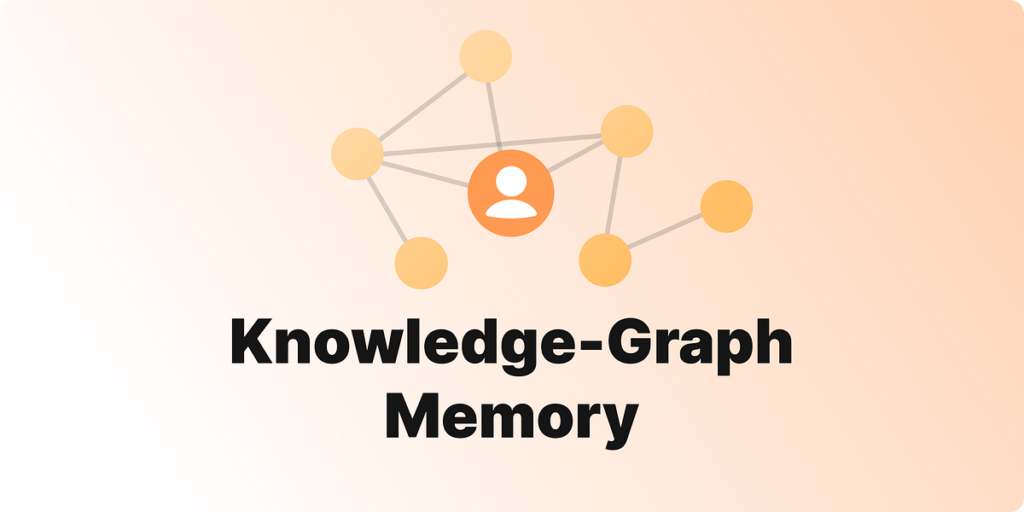
Memory graph implementations represent stored knowledge as nodes and edges rather than as independent embedding vectors. Nodes represent entities: people, tasks, concepts, system components, decisions. Edges represent the typed relationships between them: depends on, owns, supersedes, contradicts, references. A multi-hop query traverses these edges rather than executing a nearest-neighbor search, which means the retrieval mechanism is structurally aligned with the reasoning pattern the query requires.
The practical consequence is that relationship density increases retrieval value rather than degrading it. In a vector store, adding more records increases the probability that irrelevant records surface alongside relevant ones. In a memory graph, adding more edges between existing nodes makes multi-hop traversal more precise because the relationship structure encodes context that similarity scoring cannot capture.
When Multi-Hop Reasoning Defines The Use Case
The decision between vector and graph memory reduces to a single diagnostic question: does the agent need to answer questions about relationships between stored entities, or does it need to answer questions about the content of stored entities? The first pattern requires a memory graph. The second pattern is well served by vector retrieval.
Research agents, code architecture assistants, and long-running AI project management agents consistently fall into the first pattern. The queries they encounter are relational: what decisions constrain this component, which prior tasks conflict with this new requirement, which team members have context on both sides of this dependency. Answering these queries by semantic similarity search produces responses that are plausible but structurally incomplete, because the relevant information is in the edges between nodes rather than in the content of any individual node.
Conversational assistants and personal productivity agents more often fall into the second pattern. Retrieving a user’s stated preference, recalling a prior decision, or surfacing a relevant past interaction does not require multi-hop traversal. Vector retrieval handles these cases with lower infrastructure overhead and simpler operational maintenance than a graph database requires.
Hybrid Architectures and The Cost of Choosing One
Production memory systems in 2026 increasingly combine both approaches rather than selecting one. The vector store handles flat fact retrieval and semantic similarity lookups. The memory graph handles relational queries and multi-hop reasoning. The routing layer directs each query to the appropriate retrieval mechanism based on query structure rather than executing every query against both stores.
The implementation cost of a hybrid architecture is real: two storage backends, a query router, and consistency maintenance across both stores when a memory write must update both. For agents whose query patterns are predominantly flat retrieval with occasional relational queries, that cost outweighs the benefit. For agents where multi-hop reasoning is a core operational requirement, the cost of not having graph retrieval is measured in structural answer failures that accumulate silently across every session the agent runs.
Conclusion
Memory graph and vector store architectures are not competing implementations of the same retrieval idea. They encode different assumptions about what stored knowledge looks like and what queries will be run against it. Vector stores are optimized for content similarity under the assumption that records are independent. Memory graphs are optimized for relationship traversal under the assumption that the connections between records carry as much operational value as the records themselves. Identifying which assumption matches the agent’s actual query distribution is the architectural decision, and making it correctly before infrastructure is committed determines whether retrieval behavior scales with knowledge accumulation or degrades as it grows.